Library

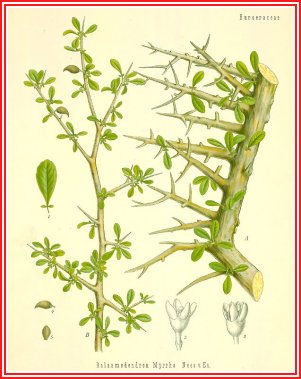
The Resins of the BP and
BPC
Martindales 24th Edition.
2
Parts
Compiled
by Ivor Hughes.
The
introduction to the Resins is taken from a Textbook of Pharmacognosy
by T.C. Denston. The image is from Kohlers Medicinal Plants and
depicts Myrrh (Commiphora molmol)
Denston's concise monographs are a pleasure to read and deserve to be
more widely read.
.-:-:-
RESINS, GUM-RESINS, AND OLEO-RESINS (Br.)
THE resins commonly used in pharmacy are derived from living natural
sources, and most are plant products-shellac, an insect secretion, being an
important exception. The resinous exudation may consist almost entirely of
resin, e.g. benzoin; it may be an oleo-resin, i.e. resin associated with
volatile oil, e.g. turpentine, copaiba; or a gum-resin, i.e. resin
associated with gum; if a considerable proportion of volatile oil is
also present the substance is called an oleo-gum-resin, e.g. myrrh.
Gum-resins and oleo-gum-resins are commonly grouped together as
gum-resins. Those resins or oleo-resins which contain benzoic or
cinnamic acid either free or combined are commonly called balsams,
e.g. Benzoin, Balsam of Tolu, Balsam of Peru, Storax.
RESINS.
All resins are practically insoluble in water. They dissolve more or less
completely ill organic solvents, e.g. alcohol, oil of turpentine; those
containing resin acids are usually proportionately soluble in alkalis.
A solution of a resin in a volatile solvent, when painted on a smooth
surface should rapidly and completely dry to form a hard transparent film;
to be suitable for varnish the film should not darken with age or
become impaired upon exposure to light or moisture.
Formation of Resins.
In many instances resin in plants is formed in special passages or tubes
called resin ducts, which usually anastomose: thus a single incision may
drain the resin from a considerable area of the plant. The cells
lining the duct possess a layer (called the resinogenous layer) of
slimy matter bounded by a fine cuticle and, according to Tschirch,
resin is secreted in this layer and excreted through the cuticle into
the resin duct. In some cases, e.g. copaiba, numerous resin ducts are
present. and although tapping is necessary. to drain the ducts, the
wound per se is in no way responsible for the production of the resin,
which is thus termed a normal or physiologically-produced resin.
In other instances, e.g. turpentine, only a few resin ducts are normally
present, but following injury to the cambium the new (secondary) wood
subsequently formed contains a very large number of ducts, and the resin
from these is called wound, traumatic, or pathologically-produced
resin. Resin may continue to flow for a considerable period from
wounding, or in some cases it may be necessary to inflict wounds at
frequent intervals. Further, invasion of the wound by fungi and
bacteria sometimes plays an important part in the composition of the
resin exuded. To illustrate, the simple wound resin of Styrax Benzoin
differs materially from the resin exuded after fungal invasion of the
wound.
Composition of Resins.
Resins are not single chemical compounds, but are usually mixtures of
substances of different and complex chemical characters.
The following are the three more important groups of compound present in
resins;
1. Resin Esters.These
consist mostly of resin alcohols combined with aromatic acids, of
which benzoic and cinnamic acids are of frequent occurrence; other
aromatic acids are less frequently found, e.g. ferulic acid (in asafetida).
There are two principal kinds of resin alcohols in combination with
these acids.
(a) Resinols -
These
are colourless, and give a negative reaction when tested with iron
salts. The resin in benzoin consists principally of the resinol,
benzoresinol, combined with cinnamic and benzoic acids.
(b) Resinotannols - These are
phenolic compounds, and give blue, green or violet-coloured compounds
with ferric chloride. They are usually named from their source, e.g.
the resinotannol in balsam of Tolu is called toluresinotannol, and it
occurs combined with benzoic and cinnamic acids; that from Sumatra
benzoin is called sumaresinotannol, and it is similarly combined. Like
other esters, the resin esters are saponified when boiled with alcoholic
solution of potassium hydroxide, and the previously combined acid obtained
as a water-soluble potassium salt. From the latter the aromatic acid
(practically insoluble inwater) may be obtained by distillation
of the reaction mixture (to remove the alcohol}, extraction of the
residue with water , and acidification of the solution with a mineral
acid, whereupon the aromatic acid is precipitated.
2. Resin Acids.
These acids, also called resinolic acids, are of high molecular weight
and very complex. They usually occur free, and preponderate in some resins,
e.g. 90 per cent or more of colophony (American) consists of the resin
acid called abietic acid.
3. Resenes.
The chemical nature of these compounds is unknown. They are very stable,
being unaffected by most chemical reagents or by exposure to moisture and
light-hence resins consisting principally of resenes yield good varnishes
provided the film is hard and therefore resistant to mechanical injury. The
resenes are usually named from their source, e.g. that of Sandarac is called
Sandaracoresene. The resene containing resins are, of course, those chiefly
used in the manufacture of varnishes. Sandarac is used in pharmacy for
making pill varnish.
Classification.
Various more or less unsatisfactory attempts have been made to classify
resins according to principal components; the following classification
includes the resins, gum-resins, and oleo-resins described in this
book.
1.Resins consisting principally of
Resin and other Esters, together with free Aromatic Acids.
Resin, Resin or other Gum-Resin Esters Aromatic Acids or Oleo-Resin
Benzoin (sumatra) {Benzoresinol
and Sumaresinotannol}Cinnamic Acid 11 % combined with cinnamic and
benzoic acids 60% Benzoic Acid 9%.
Asafetida.
Asaresinotannol combined with ferulic acid.
Balsam of Peru.
Peruresinotannol combined with cinnamic and benzoic acids 28%. Benzyl
benzoate and cinnamate 58 - 70%.
Storax. Storesinol,
free and combined with 35-40% Cinnamic Acid 16-24% Storax Cinnamates
of ethyl phenylpropyl and 25% cinnamyl alcohols (average)
Balsam of Tolu.
Toluresinotannol combined with cininamic and benzoic acids 80% Cinnamic
Acid 12%
Benzyl benzoate and cinnamate 7.5% Benzoic Acid 8%.
2. Resins consisting principally of Resin
Acids.
Resin, Oleo-Resin or Gum-Resin and Resin Acids :
Colophony: Copaiba, Myrrh :
3. Glyco-Resins.
This important and complex group comprises the glycosidal resins, which
are so-called because when they are boiled with mineral acids hydrolysis
takes place, with production of a sugar (usually dextrose) and a
complex resin acid and simpler acids. Jalap resin and Ipomoea resin
are examples of glyco-resins.
CHEMICAL EXAMINATION OF RESINS.
The acid value, saponification value, and iodine value may be determined
on lines similar to those for fixed oils and fats. The saponification and
iodine values are rarely criteria because they differ widely in
samples of genuine drug. The acid value is, however, of some
importance, particularly in examining resins for varnish making,
because these often consist of a mixture of resin acids and resenes in
fairly constant proportion. In such cases determination of the acid
value serves to detect adulteration with cheaper resins containing more
free acid (e.g. colophony) or less.
Benzoin, balsam of Tolu and storax are officially required to contain a
defined proportion of balsamic acids (benzoic and cinnamic), and balsam of
Peru 50.0-70.0 per cent of ester (benzyl cinnamate and benzoate).
Specific analyses for these are described in the Pharmacopeia. In many
instances, the Pharmacopeia prescribes solubility tests to guard
against adulteration or to limit the proportion of impurities. For
example, not more than 24.0 per cent of benzoin should be insoluble in
90 per cent alcohol, indicating absence of an undue amount of wood debris,
etc.
Martindales 24th Ed. BENZOIN and other
RESINS.
Benzoin (B.P.) Sumatra
Benzoin; Gum Benzoin; Gum Benjamin; Benzoe.
Dose:
0.6 to
2 g. (10 to 30 grains). A balsamic resin from the incised stem of
Styrax benzoin and of S. paralleloneurum (Styracacere) and containing
various esters of benzoic and cinnamic acids together with the free
acids. (Note. The B.P. 1948 allowed both Sumatra benzoin and Siam
benzoin).
Foreign Pharmacopeias: In Chin., Cz., Egyp., Hung.,
Ind., Jap., Mex., and U.S., all of which allow both Siam benzoin and
Sumatra benzoin. In Belg., Chit., Dan., Fr.,Ger., Jug., Nor., Span.,
Swed., and Swiss, all of which specify Siam benzoin only.
Hard brittle masses of whitish tears embedded in a greyish-brown to
reddish-brown translucent matrix; it has an agreeable balsamic odour and a
slightly acrid taste. Store in a cool place,
Uses. Benzoin
acts as a reflex expectorant but it is seldom given internally.
Siam Benzoin (BPC) A balsamic
resin from the incised stem of Styrax tonkinensis (Styracacere) and
containing about 68% of crystalline coniferyl benzoate together with
free benzoic acid, ( +) siaresinolic acid, vanillin, and a small amount of
cinnamyl benzoate.
Foreign Pharmacopeias: In many
pharmacopeias. under the title Benzoin (see above under Benzoin).
In flattened irregular tears or ill irregular masses consisting of tears
embedded in a brownish-red, translucent, resinous matrix. The tears are
usually about 1 to 2 cm. wide and about 0.5 to 0.7 cm. thick;
externally they are covered with a brownish-red varnish-like layer of
resin, but the freshly fractured surface is milky white. Siam benzoin
resembles Sumatra benzoin in odour and taste.
Store
in a cool place.
Uses. It is used to inhibit
the development of rancidity in fats, its action being apparently due to
the presence of coniferyl benzoate. It is a more efficient preservative than
Sumatra benzoin, and is used in the preparation of Benzoinated Lard.
Compound Benzoin Tincture (U.S.P) Prepared by
macerating benzoin (Sumatra or Siam) 10 g., aloes 2 g., storax 8 g.,
and balsam of tolu 4 g., with alcohol to 100 mI.
Compound Tincture or Benzoin (B.P.)
Tinct. Benzoin. Co. Friars' Balsam;
Traumatic Balsam. Prepared by maceration from Sumatra benzoin (10%),
prepared storax, aloes, balsam of tolu, and alcohol (90%).
Dose: 2 to
4 ml. (30 to 60 minims). Uses. It is occasionally used internally in
chronic bronchitis; 60 minims to a pint of hot water is employed as an
inhalation in bronchitis and acute laryngitis. Undiluted it is used
as an antiseptic and styptic to small cuts. Mixtures require the
addition of equal parts of mucilages of acacia and tragacanth to
suspend the resins, the total amount of mucilage being one-eighth of
the volume of the mixture.
Inhalation or Benzoin (B.P.C.). Vap. Benzoin. (B.N.F.)
Prepared by macerating Sumatra benzoin 45 gr.
and prepared storax 30 gr. with alcohol to 1 fI. oz.
Lot. Benzoin. (B.P.C; 1934) Lotion of
Benzoin; Lait Virginal. Tincture of benzoin 2.5 mI., rose water to 100
ml. Useful as a face lotion in urticaria and other irritable skin
conditions.
Neb. Benzoin. Co. (B.P.C. 1934). Compound
Benzoin Spray. Pumilio pine oil 1.5 ml., eucalyptus oil 3 ml., cassia
oil 1.5 ml., mentholl g., glycerin 50 ml., tincture of benzoin to 100
ml.
Tincture or Benzoin (B.P.C.) Tinct.
Benzoin. ; Simple Tincture of Benzoin. Sumatra benzoin 1 in 10,
prepared by maceration with alcohol (90%). Dose: 2 to 4 ml. (30 to 60
minims).
Similar tinctures in Belg.
P., Chin. P., Cz. P., Dan. P., Fr. P, Jug. P., Span. P., Swiss P. and
U.S..P. which are all l in 5.
Balsam of Tolu (B.P.) BalsamumTolutanum.
Foreign Pharmacopeias: In Belg., Chil., Dan., Egyp., Fr., Ger., Ind.,
Jap., Jug.,Mex., Nor., Span., Swed., Swiss, and U.S.
A balsam obtained by incision from the trunk of Myroxylon balsamum (= M.
toluiferum) (Leguminosae). It is a soft, tenacious, brownish-yellow or brown
resinous solid when fresh, but it subsequently becomes harder and finally
brittle. It has an aromatic odour and taste. Almost
insoluble in water and light petroleum;
soluble in alcohol, benzene, chloroform, ether, and
glacial acetic acid; partly soluble in solutions of caustic alkalis;
partly soluble in carbon
disulphide, the soluble portion consisting chiefly of cinnamic acid.
Uses. It has a
very mild antiseptic action but is mainly used as a reflex
expectorant. The syrup is a common ingredient of children's cough
mixtures.
[P1] Compound Linctus of Tolu for Infants (B.P.C.).
Linct.Tolu. Co. pro Inf. (B.N.F.). Citric acid
112 gr., syrup of wild cherry 20 m., glycerin 15 m., syrup of tolu to
60 m. Dose: 2 to 4 ml. (30 to 60 minims)
Solution of Tolu (B.P.C.). Liq. Tolu. Prepared from
balsam of tolu 10 g., alcohol (90%) 30 ml., sucrose 50 g., and water
to 100 ml. One volume with 7 of syrup yields a preparation more
aromatic than syrup of tolu.
Syrup of Tolu(B.P.). Syr. Tolu.
Prepared from balsam of tolu 2.5 g., sucrose 66g. and water to 100 g.
Dose: 2 to 8 ml.
(30 to 120 minims).
Tincture of Tolu (B.P.C.) Tinct. Tolu.;
Tolu Balsam Tincture. 1 in 10 of alcohol (90%). Several pharmacopeias
(Belg., Chil., Dan., Fr., Mex., Swed., and U.S.) specify 1 in 5. In
mixtures the resin must be suspended with mucilage.
Dose: 2 to 4 ml.
(30 to 60 minims).
Tolu Balsam Syrup (U.S.P.)
Syrup
of Tolu. Tolu balsam tincture 5 ml., triturated with magnesium
carbonate 1 g., sucrose 6 g., water 43 ml., and filtered; sucrose 76
g. dissolved in the filtrate, strained, and diluted to 100 ml.
Tolu Basis for Lozenges (B.P.C.) For 100 lozenges: tincture
of tolu 2 ml., sucrose 100 g., acacia 7g., water q.s.
Vernix Tolutana (Dan. P.)
Tolu
Varnish. Balsam of tolu 16.5 g. dehydrated alcohol 25 g. ether 58.5g.
Ammoniacum (B.P.C. 1949).
Dose: 0.3 to 1 g.
(5 to 15 grains).
Foreign Pharmacopeias: In Belg., Fr., GeT., Nor., Span., and Swiss.
A gum-resin from the flowering and fruiting stem of Dorema ammoniacum and
possibly other species of Dorema (Umbelliferae). Pale yellow tears or
nodular masses with characteristic odour and acrid taste.
Uses. It has been
used to facilitate expectoration in chronic bronchitis with viscid
secretion.
Note: Ammoniacum
is dilute solution of ammonia in Chil.P. and strong solution of
ammonia in Span.P
Asafetida (B;P.C. 1949) Gum Asafetida; Devil's Dung; Asant.
Dose: 0-3 to 1 g.
(5 to 15 grains). Foreign Pharmacopeias: In Belg., Egyp., Ger., Ind.,
Span., and Swiss. Also in U.S.N.F.
An oleo-gum-resin obtained from the living rhizome and root of Ferula
assafoetida, F. foetida, F. rubricaulis, and probably other species of
Ferula (Umbelliferae). It is in the form of greyish-white or yellow
tears with a garlic-like odour and bitter acrid taste.
Store
in a cool place.
Uses. Asafetida
has a carminative action and has been employed in intestinal
flatulence, sometimes as an enema. It also has an expectorant action
and has been used in bronchitis. It was at one time widely used for its
supposed effect in nervous disorders, but any effect it might have in these
conditions is attributed entirely to the psychological response to the
objectionable odour and taste.
Asafetida Pills (U.S.N.F.) Each
contains asafetida 200 mg. and hard soap 60 mg. Usual
dose: 2 pills.
Enema Asafoetidae (B.P.C. 1934) Tincture of asafetida 6 to
12% v/v in mucilage of starch.
Dose: 120 ml.
(4f1. oz.).
Mist. Asafoet. Co. (Cape Hosp.). Mist. Diabolica. Tincture
of asafetida 15 m., cod-liver nil 15 m., solution of potassium hydroxide 10
m., infusion of quassia to � .f1. oz.
Pil. Asafoet. (B.P.C. 1949) Each
contains asafetida 3 gr. and hard soap 0.75, gr. massed with water. If
required to be coated the pills should first be coated with acacia
mucilage and, when dry, with pill varnish.
Dose:
1 or 2
pills.
