
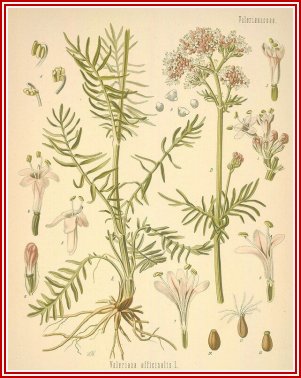
Valerian
Martindales
24th Edition and Denstons Pharmacognosy
Compiled and Edited By Ivor Hughes.
VALERIAN
Valerian (B.P.C.).
Valerian Rhizome; Valerian Root.
Dose: 0.3 to 1 g. (5 to
15 grains).
The dried rhizome and roots of Valeriana officinalis
(Valerianacere), containing not less
than 18% of alcohol (60%) -soluble extractive.
Foreign Pharmacopoeias:
In Belg., Chil., Cz., Dan., Egyp., Fr., Ger., Hung., Jap., Jug., Nor.,
Pol., Span., and Swiss (from V. officinalis); in !nd. (from V.
officinalis and V. wallichii); in Swt!d. (from V. officinalis, V.
salina, and V. sambucifolia).
The B.P.C.
1949 also included Indian Valerian, the
dried rhizome and roots of V. wallichii..
Valerian contains an
odourless crystalline principle (methyl 2-pyrrolyl ketone), a volatile
alkaloid, and about 1% of volatile oil.
Protect from
air, light, and moisture.
Note. The odour of valerian may be removed
from a scale pan or from the hands by rubbing with sodium bicarbonate.
Uses. Valerian
depresses the central nervous system; this action is probably due to
the odourless crystalline principle. It is used as an extract,
infusion, or tincture, often in conjunction with bromides, chloral hydrate,
and phenobarbitone, in the treatment of hysteria and other nervous
conditions. It is also used as a carminative.
Elixir
Elix. Valerian. et
Chloral. Co. (B.P.C. 1949,
N.F. 1952)
Compound Elixir of
Valerian and Chloral; Compound Elixir of. Valerian; Compound Elixir of
Bromide and Valerian.
Liquid extract of valerian 15 m., potassium bromide 7 1/2. gr., chloral
hydrate 7 1/2 gr., liquid extract of liquorice 10 m., compound spirit of
orange 24 m., syrup 120 m., water to 1 fl. oz.
Dose:15 to 30 ml. (11. to 1 fl. oz.)
Extracts
Extract of Valerian (B.P.C.). Ext. Valerian.
A soft alcoholic extract. Protect from air and moisture in a cool place.
Dose: 60 to 300 mg. (1 to 5 grains).
Liquid Extract of Valerian (B.P.C.). Ext. Valerian. Liq. 1 in 1; prepared by percolation
with alcohol (60%).
Dose: 0.3 to 1 ml. (5 to 15 minims}.
Infusions
Concentrated Infusion of Valerian (B.P.C.)
Inf. Valerian. Conc. 1 in 5; prepared by percolation with
alcohol (25%}
Dose:2 to 4ml. (30 to 60 minims}
Infusion of Valerian is prepared by diluting 1 vol. of the concentrated
infusion to 8 vol. with water.
Inf. Valerian. Rec. (B.P.C. 1949}
Fresh Infusion of Valerian.
Valerian, bruised, 2.5 g. and boiling water 100 g., infused in a covered
vessel for 15 minutes and strained.
Dose:15 to 30 mI. (� . to 1 fl. oz.}
Mixture
Mixture of Potassium Bromide and Valerian
(B.P.C.)
Mist; Pot. Brom. el Valerian. (B.N.F.)
Potassium bromide 10 gr., ammonium bicarbonate 211. gr., concentrated
infusion of valerian 30 m., chloroform water to 11. 6. oz.
Dose: 15 to 30 ml. (11. to 1 6. oz.}.
PRECIPITATE. A slight deposit was observed in
certain samples, the amount depending on the batch of concentrated
infusion of valerian used. Replacing the concentrated infusion by an
equivalent amount of the liquid extract produced mixtures with a very
slight deposit or none at all.-Pharm. Soc. Lab. Rep.,
Pharm. J., i11956, 383.
Tinctures
Ammoniated Tincture of Valerian (B.P.C.)
Tinct. Valerian. Ammon.
About 1 in 5; prepared by maceration with alcohol (60%), nutmeg oil, lemon
oil, and dilute solution of ammonia.
Dose:2 to 4 ml. (30 to 60 minims}.
Tinct. Valerlan.
Ammon. Conc. (B.P. 1932}.
Concentrated Ammoniated Tincture of Valerian.
Valerian or Indian valerian 800 g. is exhausted by percolation with alcohol
(60 %) the alcohol is removed from the percolate by distillation under
reduced pressure and the residue evaporated to a soft extract at a
temperature not exceeding 60�; the soft extract is dissolved in about
800 ml. of alcohol (60%} and the solution filtered; nutmeg oil 12 ml., lemon
oil 8 ml., and strong solution of ammonia 133 ml. are then added, and
the tincture diluted to 1000 ml. with alcohol (60 %)
Dose: 0.5 to 1 ml. (8 to 15 minims}.
Concentrated
ammoniated tincture of valerian is about 4 times as strong as ammoniated
tincture of valerian.
Tinct. Valerlan. Simp. (B.P.C. 1949).
Simple Tincture of Valerian;
Tincture of Valerian. 1 in 8; prepared by maceration with alcohol (60
%)
Dose:
4 to 8
ml. (60 to 120 minims}
Many foreign pharmacopoeias include a 1 in 5
tincture;
Jap. P. 1 in 10.
Denstons Text Book of pharmacognosy :
VALERIAN.
Synonyms
: Valerian
Rhizome; Valerian Root.
Botanical Source
The rhizome and roots of Valeriana officinalis Linn., collected
in the autumn and dried.
Fam. :
Valerianacere.
Geographical Source
Great Britain, Belgium, Holland, and Northern France.
Plant Habit
An erect herbaceous perennial, from I to 1.5 metres in height, with
decussately arranged leaves, the upper ones being widely spaced. The leaves
are imparipinnate with lanceolate leaflets about 5 cm. long.
Two varieties are distinguished differing in their habitat and the
shape of the leaves. V. officinalia var.
sambucifolia
Mikan, has fewer broader leaflets usually
toothed on both margins, and V.
officinalia var. Mikanii Syme, has more numerous
leaflets (six or more pairs) usually without serrations on the anterior
margin.
The inflorescence consists of small white or pinkish flowers in
terminal panicles. The fruits are small, dry, and one-seeded with a pappus
at the apex, developed from the calyx.
Cultivation
British cultivators prefer the latter variety because it yields a more
robust root with a larger percentage of oleo-resin. The rhizomes and
roots, often with the stolons and offsets, are collected in the
autumn, washed, and large specimens sliced longitudinally. Drying
should be effected as rapidly as possible to check the development of
the characteristic valerian odour, which is not present in the living
plant
(vide infra). The
continental drug is mainly from cultivated plants and constitutes the
bulk of commercial supplies.
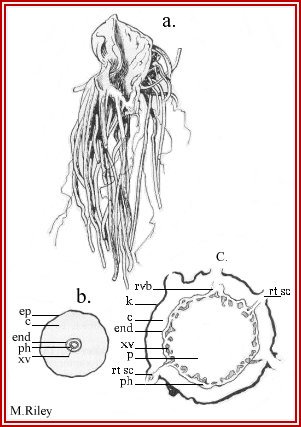 VALERIAN
(V. officinalis)
VALERIAN
(V. officinalis)
(a)
Longitudinally sliced rhizome
with roots, x 1
(b) Transverse section of root, X
6
(c) Transverse section of rhizome, X 3
c. = cortex
end. = endodermis
ep. = epidermis
k. = cork
p. = pith
ph. = phloem
rt. sc. = root scar
r.v.b. = vascular bundle to root
z,v = xylem vessels
Constituents
Volatile Oil,
0.5-1.5 per cent, secreted in the sub-epidermal layers of the rhizome
and roots. The variation in quantity and composition is due to the
environment of the plant, especially humidity, and to the method of drying
and the age of the drug. It contains borneol and its formic, acetic
and isovalericesters. Free isovaleric acid is not pre-existent in the
plant, but is liberated by enzyme action, and gives the drug its
characteristic odour
The therapeutic action of the drug depends chiefly upon the natural
constituents of the volatile oil, and the only means of maintaining these
unaltered is by stabilization of the rhizome immediately after collection.
Free isovaleric acid is inert, and therefore specimens of the drug or
its preparations with a strong odour are inferior.
Japanese Valerian contains from 6 to 8 per cent of volatile oil, with a
considerable quantity of free isovaleric acid.
Resin, partly formed by resinification of
the volatile oil. English drug yields about 1.6 per cent, and Belgian
about 1.3 per cent, of oleo-resin.
Alkaloids, about 0.1 per cent, principally
chatinine with some valerine. Their physiological activity is
doubtful.
Mucilage is also present.
An odourless crystalline principle, pyrryl methyl ketone has been
isolated from Valerian and it is claimed to depress the central nervous
system.
Standard. B.P C. requirements include not less than
18.0 per cent of alcohol (60 per cent)-soluble extractive (commercial
samples may yield up to 28 per cent), and not more than 10.0 per cent
of acid-insoluble ash (samples which have been inadequately washed may
exceed this figure).
