
 Tea Tree Oils of the Oceania Region.
Edited and introduced
by Ivor Hughes.
The following article was
reproduced from a document in my personal files.
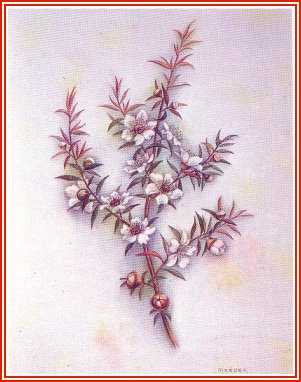
The botanical painting on the left is of Leptospermum scoparium It was
painted by the late Fanny Osbourne.
The original is held by the Auckland Museum.
Before proceeding to Drs Penfold and Morrisons monograph, it must be mentioned
that New Zealand is also home to two members of the Leptospermum i.e.
L. ericoides (White Manuka) and L. scoparium (Red tea tree)
Calder, Cole, Walker. - Antibiotics from New Zealand plants. State that both
species exhibit antibiotic properties against the following test
organisms; S. aureus,
B. sub, C .alb, E. floc.
 |
|
|
|
|
ESSENTIAL OILS OF THE PLANT FAMILY MYRTACEAE
"TEA TREE" OILS"
by
A. R. PENFOLD, Director and F. R. MORRISON,* Economic Chemist,
Museum of Technology and Applied Science, Sydney, Australia.
Introduction.- Australia is rich in myrtaceous shrubs
and small trees belonging to such genera as
Leptospermum, Melaleuca, Kunzea, Baeckea, etc: which
are collectively known by the vernacular term of "Tea Trees" (not "Ti
-Trees")
This popular name arose from the story of Captain Cook's sailors having used
the leaves of a species of Leptospermum as a substitute for tea. Hundreds of
species of "Tea Tree" occur in Australia. The essential oils' of many have
been examined, but only a few have attracted commercial attention.
OIL OF LEPTOSPERMUM CITRATUM CHALLINOR, CREEL AND PENFOLD
Botany
-This species was raised to
specific rank by Challinor, Cheel and Penfold (1) in 1918. It had
previously been described as Leptospermum flavescens, var. citratum.
Leptospermum citratum is a glabrous shrub or small tree, varying in
height from 4 to 25 ft., the main stem often exceeding 3 in. in
diameter, the bark of light brown color, comparatively thin and smooth on
the upper branches, and fibrous and furrowed on the lower part of the
stem. The flowers are white, solitary in the axils of the leaves, or
occasionally terminal on the lateral branchlets, sessile, or very
shortly pedicellate.
Habitat, Range, and
Occurrence.- This small
tree grows on rocky ledges in inaccessible parts of the Dividing Range
of eastern Australia, and is very sparsely distributed. Small stands
occur at Copmanhurst, Macpherson Range, Punchbowl, Whiteville, and
Baryulgil, all in northern New South Wales, and at Spring brook and Palmwood
in Queensland.
The authors are greatly indebted to Mr. H. H. G. McKern, Assistant Chemist,
and Mr. J. L. Willis, Botanical Research Officer, Museum of Technology and
Applied Science, Sydney, Australia, for their assistance in the preparation
of this chapter. 11. Proc. Roy. Soc. N. S. Wales 52 (1918) 175.
Planting and Cultivation.-It was early realised that this attractive
shrub, which had been grown as a garden hedge, would have to be cultivated
if commercial demands for its essential oil were to be met. Many
experimental plots have been established in Australia, and much
information on cultivation is available. The only commercial plantations in
the British Empire are located in Kenya Colony, although Naves reports
an analysis of an oil sent to him from Rhodesia by the distiller.
Outside of the Empire, the tree is grown in Guatemala.
Yield of Oil.-One thousand pounds of leaves and
terminal branchlets yield from 10 to 15 lb. of a pale lemon colored
oil containing from 75 to 85 per cent of the aldehydes citral (45 to
50 per cent) and citronellal (35 percent)
Distillation.- Portable field stills, similar to those
described in the monograph on Australian Eucalyptus Oils, are employed
for the distillation of Leptospermum citratum. The general procedure
of distillation resembles that of the eucalyptus oils in every
respect.
Physicochemical
properties.
Specific Gravity at 15/15. 0.8792 to 0.8856
Optical Rotation. +3' 30" to +5' 0"
Refractive Index at 20. 1.4688 to 1.4757
Total Aldehyde Content (Citral and Citronellal) : 75 to 85%
Solubility in 70% Alcohol (W/W) ..Soluble in 1 to 1.2 vol.
Use.- The oil is an
excellent source of citral and citronellal. The citral isolated from
it is superior to that from any other source, with the possible
exception of Backhousia citriodora. The oil has also been used as a
fortifier or modifier in perfume compounds where citral or
citronellal-containing oils are employed. It has proved helpful in eau de
Cologne, toilet waters, hair oils, powder perfumes, hair washes, and shampoo
preparations.
Physiological Forms.-Aside from the Type oil discussed above,
two physiological forms of Leptospermum citratum were described in
1942. The two forms are readily distinguished in the field by crushing
the leaves between the fingers. The leaves of variety A " emit a
terpene-like odor resembling 'Y-terpinene, whereas the foliage of
variety "B" gives a rose-Iike odour characteristic of geraniol and its
esters.
Physicochemical
Properties.Oil of Leptospermum citratum.
|
Variety "A" |
Variety "B" |
|
Specific Gravity at 15/15 0.862 to 0.8634 |
0.881 to 0.884 |
Oil of Melaleuca
alternifolia. Cheel.
Botany.-This species was
raised to specific rank by Cheel. It had previously been described by
Maiden and Betche as a variety of Melaleuca linariifolia. The tree
bears a. superficial resemblance to Melaleuca linariifolia, but is distinct
botanically. Both trees are "Narrow-leaved" paper bark "Tea Trees,"
but Melaleuca alternifolia is not as tall as M. linariifolia, the
height not exceeding 20 ft. The leaves are alternate, narrower, and
usually shorter than those of M. linariifolia. The whole plant is
glabrous and the flowers are generally scattered in an interrupted
spike.
Habitat, Range, and
Occurrence.-Melaleuca
alternifolia follows water-courses and flourishes in swampy
situations. The tree occurs in fairly large stands in the Northern
Rivers districts of New South Wales, from the southern limit at
Stroud, through the coastal rivers to southern Queensland.
Planting and Cultivation.-Melaleuca alternifolia responds readily
to cultivation from seed, and good results have been obtained in
experimental plantations. Notwithstanding the export demand for the
oil of M. alternifolia, the existing stands have so far met all
requirements. However, fairly large areas of country are destroyed
from time to time by bush fires.
Collection of
Leaf Material.-To collect
the leaf material the trees are cut down to within 5 or 6 ft. of the
ground, and the limbs are cut off. The leaves are removed with a cane
knife, and allowed to drop upon squares of hessian, each holding from
40 to 80 lb. The foliage is then carted to the distillery. Within
eighteen months to two years after cutting of the original trees, new
growth, known as "ratoon," makes its appearance. Depending upon climatic
conditions, this new growth is ready for cutting within eighteen months to
two years.
Distillation.-Two methods are employed in distilling
the leaves of this species-namely, distillation in directly fired stills,
and distillation of the foliage with live steam generated in a
separate boiler. The stills used for direct firing resemble those
described in the monograph on " Australian Eucalyptus Oils," in the
section on "Production." Made of mild steel, and holding from 1.5 to 2
tons of leaves, they are connected to a water tank of approximately
1,500 gal. capacity, in which the condenser coil for cooling of vapors is
placed. The distillation occupies about 6.5 hr
The large plants using
live steam employ boilers
ranging from 24 to 40 h.p. The stills used in this operation are
slightly smaller than those employed for direct firing, as they do
not. require a water space in the bottom of the stills. A wire tray to
support the foliage. rests immediately on top ofthe steam pipes, and
live steam of about 15 to 20 lb. pressure is passed through the
leaves.
The oil and steam are
condensed in the same
manner as in the case of the directly fired still. The methods of
packing and emptying the still are essentially the same, and there is
no difference in the yield and quality of the oil.
The live steam unit
consists of a steam
boiler with three stills, each with .its separate condenser tank.
Overhead derricks or endless chain blocks are used to empty the stills
rapidly.
Directly fired stills are
used where the stands of
Melaleuca alternifolia are not sufficiently large to warrant steady
all-year-round operation of a still. In order to keep a large steam
plant busy it is necessary to have sufficient stands of the tea tree
within a radius of about 12 miles of the distillery.
Yield of Oil.- One thousand pounds. of leaves and
terminal branchlets yield about 18 lb. of a pale lemon-tinted oil
possessing a pleasant nutmeg odor. The yield of oil is lo\ver in the
winter months than in the summer, a sudden increase appearing in
November, the first month of summer, The yield declines again about
June, the first winter month in Northern New South Wales.
As regards the cineole content of the oil, an increase appears to occur in
the winter months, corresponding to the lowered yield.
Physicochemical
Properties.
Specific Gravity at 15/15. 0.8950 to 0.9050
Optical Rotation. + 6 48' to + 9: 48'
Refractive Index at 20 1.4760 to 1.4810
Ester Number. 2 to 7
Ester Number after Acetylation. ..80 to 90
Cineole Content. Under 10%
Solubility in 80% Alcohol (w/w) Soluble in 0.6 to 0.8 vol.
Use.-The complex mixture
of substances constituting this oil possesses a high germicidal value
when tested against pure phenol, with B. typhosus as test organism.
The germicidal activity, the pleasant odor, and non poisonous, non
irritant, and non corrosive properties of the oil have resulted in its
extensive application in surgical and dental practice. The great value of
the oil in medical practice is due to its property of penetrating pus, and
of mixing with it in a manner which causes it to slough off, leaving a
healthy surface.
The following pathological
conditions have responded
to treatment, either with the oil alone or with it in a water soluble
emulsion: Perionychia, empyema, gynaecological conditions, skin
conditions, epidermophyton infection [psoriasis] impetigo contagiosa,
pediculosis, ring worm, tinea [ albuginea], throat and mouth
conditions, acute nasopharyngitis, catarrh, thrush, and "aphthous"
stomatitis, tonsilitis and ulcers of the mouth, sore throat, pyorrhoea,
gingivitis , diabetic gangrene, etc. It has also been demonstrated that the
water soluble emulsions of Melaleuca alternifolia oil not only retain their
activity in the presence of blood and organic matter, but actually increase
in effectiveness.
An interesting technical
application of the oil is
its incorporation (about 1 per cent) in machine "cutting" oils,
whereby skin injuries, .especially abrasions to the hands by metal
filings and turnings, have been reduced to a minimum. Large quantities
of the oil were used for this purpose in munitions factories during
World War II. The oil has also found use in perfumery as a toner and
blender, and as a flavoring and antiseptic agent in denture and mouth
washes.
Physiological Forms.-The occurrence of physiological forms was
observed in 1946, when investigations revealed oils containing a high
content of cineole. (A normal distillate of Melaleuca alternifolia
contains about 10 per cent of cineole. ) Since that date it has been
noted that oils obtained from various trees of Melaleuca alternifolia
fall into the following three groups:
Type
....................... 6 to 14 per cent of cineole
Type Variety 'A' .... 31 to 45 per cent of cineole.
Type Variety 'B' .... 54 to 64 per cent of cineole.
Warning on the Use of Oils Other than "Type" for Medicinal Purposes.~ Recent analyses have shown that
the cineole content may vary from 5 to 15 per cent in the Type oil,
although the average of commercial consignments has been approximately
10 per cent. In view of clinical evidence that the oil should contain
a minimum of cineole, it is imperative that the Type oil only be used
for medicinal and dental purposes.
Oil of Melaleuca
linariifolia, Smith.
Botany, Habitat, Range, and Occurrence.-This tall, "Narrow-leaved" paper bark "Tea Tree" has
been fully described by Bentham. It occurs abundantly throughout the
coastal districts of New South Wales and Queensland, following
watercourses and flourishing in all swampy situations.
Yield of Oil.- One thousand pounds of leaves and
terminal branch lets yield from 15 to 20 lb. of a pale lemon colored
oil. Distillation.-The procedure is fully described in
the monograph on "Oil of Melaleuca alternifolia.
Physicochemical
Properties.
Specific Gravity at 15/15 , 0.8927 to 0.8992
Optical Rotation. +3. 18' to + 6.48'
Refractive Index at 20 1.4752 to 1.4780
EsterNumber 1.3t o2.7
Ester Number after Acetylation. 58 to 82
CineoleContent 16 to 20%
Solubility (w/w) Soluble in 0.8 vol. of 80% alcohol.
Use.-Although the oil
possesses a high germicidal value, the presence of cineole in quantity
renders it unsuitable for many of the applications described under
Melaleuca alternifolia. Nevertheless, the composition of the oil closely
resembles that of Melaleuca alternifolia, with the exception that cineole
largely replaces the alcohol I-terpinen-4-ol, The applications of Ithe oil,
therefore, are restricted to those where a high percentage of cineole is
unimportant, as, for example, in the manufacture of some germicides and
soaps other than those required for surgical, medical, and dental
work.
Physiological Forms.-Many samples of this oil have been
observed by ,the authors to contain cineole in excess of 20 per cent,
the figure often reach- ling 60 per cent of cineole. As in the case of
Melaleuca alternifolia this wide variation in cineole content
indicates the definite occurrence of physiologica1 forms of the
species. We have already mentioned that physiological forms of
essential oil-yielding plants are those which are identical morphologically
but which yield oils of different composition.
Oil of Melaleuca
viridiflora. Gaertner.
Introduction and Botany.-This
species was named on the basis of specimens collected by Banks and
Solander during Captain Cook's voyage to Australia in 1770. The
species has generally been described as Melaleuca leucadendron and
some authors still retain this nomenclature.
Baker and Smith, in a critical study of the so-called , Broad leaved Tea
Trees," not only separated the Australian tree from the New Caledonian but
declared Melaleuca l eucadendron Linn. extra-Australian. By reason mainly of
differences in chemical composition of the essential oils obtained from M.
viridiflora growing in different localities. Smith, established two new
species, Melaleuca maideni and Melaleuca smithii.
The present authors agree
with the views of the botanists Cheel and White that these are not
distinct species but are closely related forms of M. viridiflora.
Origin, Habitat, and Range.-Melaleuca viridiflora is trees of the genus, reaching
a height of 60 ft. It is usually found in low lying, sandy, swampy
country , not far from the sea. With its paper bark and compact bushy
foliage, consisting of rather stiff, flat parallel veined leaves, the
species presents little difficulty in identification. This broad
leaved "Tea Tree" is widely distributed, occurring all along the
coastline of Australia from Port Jackson in the south to the Gulf of
Carpentaria in the north. The tree produces an excellent, pale, hard, close-
grained timber, suitable for boat and carriage building and general cabinet
work.
Physiological Forms.-Although Melaleuca viridiftora Gaertner
is a distinct botanical entity based on morphological evidence, the
variations in the chemical composition of the essential oil warrant
its classification, for commercial purposes, according to
physiological forms. This procedure has already been adopted with
other essential oil-yielding plants which are botanically identical,
but which yield essential oils of diverse chemical composition. The
evidence available justifies the establishment of two distinct
physiological forms of Melaleuca viridiftora based upon differences in
chemical composition of the essential oils, viz., the Type, similar in
chemical composition to Cajuput oil of commerce
(containing cineole and terpineol), and Variety "
A " (containing nerolidol
and/or linalool).
Yield of Oil.- The yield of oil obtained from the
leaves and terminal branchlets varies from 1 to 2.6 per cent,
according to the physiological form.
Physicochemical
Properties.- The results
obtained from many analyses of the Type oil during the past
twenty-five years fall within the range given below. The close
resemblance of these figures with those of commercial Cajuput oil,
obtained from Melaleuca minor, and of Niaouli oil are noteworthy.
|
Type. |
Variety 'A' |
N.S.W. Trees |
| Specific Gravity at 15.5/15.5. 0.913 to 0.930. Optical Rotation - 1.36' to -5 12' Refractive Index at 20C 1.4658 to 1.4764. Ester Number. Up to 5. Ester Number after Acetylation. 20 to 60 Cineole Content. 46 to 60% Solubility in 70% Alcohol (w/w) Up to 2.5 vol. Solubility in 80% Alcohol (v/v) Up to 1 vol. |
0.8764 to 0.8800. +14 16' to +15 30' 1.4700 to 1.4719 Nil 146 to 150 Up to 2.5 Up to 1 Vol |
0.8806 to 0.8857 +13 18' to + 14 36' 1.4720 to 1.4763 2.8 tp 4.8 163 to 193 Up to 2.5 Vol. Up to 1 vol. |
Chemical
Composition.- Type.-The
following constituents have been identified by various workers:
Cineole (46 to 60 per cent) d pinene, l-limonene, dipentene, a-terpineol,
sesquiterpenes, and traces of benzaldehyde. A crystalline
sesqui-terpene alcohol m. 71C has been described by Jones and Haenke.
Variety " A."- The following constituents have been
identified: Linalool, nerolidol, some linalool monoxide,
sesquiterpenes, citral, traces of phenol and benzaldehyde.
The Queensland oil contains about 50 per cent of linalool,
whereas oil distilled in New South Wales contains about 30 per cent of
linalool and 70 per cent of nerolidol.
Introduction and
Botany.-The "Tea Tree," Melaleuca viridiflora (fam. Myrtaceae ) , is
characteristic of large areas of New Caledonia. The naming of this
species was formerly attributed to Brongniart and Gris, but
according to Baker and
Smith, the real authority
for the New Caledonian tree should be
Solander. This was accepted until quite
recently, when the Australian botanists, Cheel and White, expressed a belief that the authority should be
Gaertner
(1788).
Edwin Cheel,.in a recent private communication,
emphasized that the trees growing in New South Wales and Queensland
are botanically identical with the New Caledonian trees.
(Cf. the preceding
monograph on "Oil of Melaleuca viridiflora Gaertner.")
In New Caledonia, a French island possession in the Pacific, about 800 miles
off the east coast of Australia, the tree forms patches and sparse . forests
covering approximately two-fifths of the island. Hardy, resistant, and of
great vitality, it flourishes on swampy and rocky .soil alike, in the
coastal lowlands as well as on mountain slopes up to an altitude of
about 1,000 ft. Its sturdy, widespread roots split the schistaceous
soil and in a way prepare the ground for cultivation. It is almost
impossible to exterminate the tree by root pulling or burning, because
new shoots soon reappear from those parts of the prolific root system
which have been left in the ground. The tree quickly invades uncultivated
land, and planters consider it a nuisance-also because it is liable to
spread bush fires.
Melaleuca viridiflora is quite a decorative tree and occasionally reaches
great dimensions. During certain periods of the year large quantities of
fallen leaves cover the ground, and, since they contain an essential
oil which acts as a strong disinfectant, the native population
attributes the healthy air of New Caledonia and
the absence of malaria in certain sections to the
occurrence of Melaleuca viridiflora in these
localities.
Production of Oil.-The tree is not cultivated, as it grows
profusely over wide areas of the island. Since labor is quite scarce
and relatively high priced (it has to be imported from French
Indo-China and the Netherlands East Indies) , the production of
Niaouli oil has remained a small family industry among the
settlers-some of them French, some Asiatic. Children and women collect
the leaf material, while the men attend to the actual distillation..
The center of production
is in Gomen, whence the French term "Gomenol" for Niaouli oil.
Production of Niaouli oil in New Caledonia.
Distillation.-Most of the stills, particularly those of
small size, are directly heated. From 500 to 1,000 kg. of-freshly cut
leaves are packed into a still, trampled down, some water is poured
in, and the contents are distilled for about 6 hr. The leaves are said
to contain about 2.5 per cent of essential oil, but in the rather
primitive stills employed in New Caledonia the yield of oil from fresh
leaves ranges from only 0.6 to 1.0 per cent. It varies greatly and
depends upon climatic and seasonal conditions, the location, and most of all
upon the type of still used.
Yields
of about 2.5 per cent have been
obtained from the leaves of Australian trees.
Physicochemical
Properties.-Oil of
Niaouli closely resembles oil of Cajuput as regards physicochemical
properties and chemical composition. The oil possesses a slight
by-odor of bitter almonds (due to the presence of benzaldehyde) ,
which perhaps accounts for its popularity in France.
Gildemeister and Hoffmann recorded these properties for Niaouli oil :
Specific Gravity at 15C 0.910 to 0.929
Optical Rotation- Slightly dextro-, or (usually)
laevorotatory , + 0! 42' to 3. 34'
Refractive Index
at 20C 1.465 to 1.472
Acid Number. Up to 2.
Ester Number.
2 to 9
Cineole Content. 50 to 60%
Solubility.
Soluble in about 1 vol. of 80%
alcohol; of 70% alcohol 4 to 25 vol. are required for clear solution
In the experience of the present authors the Cineole content of
Niaouli oil ranges from 40 to 65 per cent.
Shipments of Niaouli oil received and examined by Fritzsche
Brothers, lnc., New York, had properties varying within the following
limits:
Specific Gravity at 15/15, 0.912 to 0.922
Optical Rotation
. 0.10 to +1.18'
Refractive Index at 20C. 1.4670 to 1.4722
Saponification Number. 3 to 5
Cineole Content. 52 to 57.8%
Solubility. Soluble in 1 vol. and more of 80%
alcohol.
Adulteration.-In the producing regions oil of Niaouli
is occasionally adulterated with kerosene or with fatty oils. A very
high cineole content may
indicate the addition of eucalyptus oil, which is usually lower priced than Niaouli oil.
The oil is exported from Noumea, the capital of New Caledonia, usually to
Marseilles, for distribution to various parts of Europe and transshipment to
the United States.
Use.-Because of its antiseptic properties,
the oil is used, particularly in France, as a substitute for oil of
Cajuput and oil of eucalyptus in the treatment of coughs, rheumatism,
and neuralgia. Internally, it is given by mouth or in the form of
intramuscular injections, One part of niaouli oil being diluted with
four to ten parts of a sterilized fixed oil.
The oil has been recommended also in the treatment of chronic catarrhs of
the pulmonary membrane and especially of whooping cough. Behrens
reported on the application of a mixture of 5 g. of niaouli oil and 95
g. of paraffin oil when building an oleothorax. Morin has claimed that
a solution of 0;5 g. of niaouli oil in 100 cc. of olive oil retards
development of the tuberculosis bacillus. Bernou recommends stronger
solutions, ranging from 2 to 4 per cent, for blocking the development
of the tuberculosis. bacillus, and 4 to 10 per cent solutions in cases
of tubercular empyema.
The oil has always brought a high price in France, a matter of surprise to
the authors in view of the lower prices prevailing for medicinal eucalyptus
oils produced in Australia and Spain. Perhaps niaouli oil is simply a
part of old pharmaceutical formulas, and manufacturers hesitate to
change them to eucalyptus oil. Another reason for the consistently
high price of niaouli oil may be that the oil is a medium of exchange
between France and New Caledonia. This factor has probably encouraged
the export of niaouli oil from the colony to France. From a strictly
technological point of view, the authors consider present-day
medicinal eucalyptus oils to be at least the equivalent of niaouli oil. This
oil could also be produced in Australia (New South Wales and
Queensland} from Melaleuca viridiflora growing there abundantly, but
production has been restricted because of the lower yield of oil
compared with that obtained from Eucalyptus species.
Oil of Melaleuca bracteata.
F. von Mueller.
Introduction and Botany.-This tree, commonly known as the
"Black Tea Tree," occurs in small stands in the northern
parts of New South Wales and southern Queensland. It flourishes in
favorable locations such as creeks and watercourses. In general
appearance it closely resembles another "Tea Tree," viz.,
Melaleuca trichyostachya. The leaves are small, being about 1 in.
in length. The tree possesses long terminal branchlets and calyxes ; the
bark is hard, compact, and furrowed; these characteristics distinguish
it from other paper bark "Tea Trees." The species was first. described
by Baron von Mueller. The tree attains a height of 30 to 40 ft. Yield
of Oil.-The leaves and terminal branchlets yield from 0.4 to 1.0 per
cent of a light amber colored oil, heavier-than-water.
Physicochemical Properties..
Specific Gravity at
15/15C 1.025 to 1.039
Optical Rotation at 20C -
l!24' to - 4.0'
Refractive Index at 20C
1.529 to 1.535
Acid Number 0.7to1.3
Ester Number 5.3 to 17.1
Ester Number after Acetylation. 17.0 to 32.9
Solubility in 70% Alcohol
(w/w) ...Soluble in 1.0 vol
Use.-As a source of methyl eugenol, as an
insect repellent, and for purposes similar to those described under "Huon
Pine Wood Oil" . Economics.-The
comparatively low yield of oil (less than 1 per cent) militates
against the extensive use of this oil as a source of methyl eugenol in
competition with oil of Huon pine. The wood of this latter yields from 4 to
6 per cent of oil. Huon pine wood oil is becoming scarce, and an
alternative Australian source of methyl eugenol is urgently required.
Experimental plantations of Melaleuca bracteata are therefore being
established by the authors for the purpose of obtaining high yielding
strains for commercial plantations. That the potentialities of the oil
are realized is evident from reports on samples of oil distilled from
Melaleuca bracteata grown in Kenya from seeds sent from Australia.
Physiological Forms.-Recent work at the Museum of Technology
and Applied Science, Sydney, has shown the occurrence of physiological
forms within this species. Investigating the essential oils from the
foliage of selected trees of Melaleuca bracteata occurring throughout
the eastern coast of Australia, the present authors recently obtained
very interesting results.
A number of the oils examined contained from 85 to 90 per cent of methyl
eugenol, whereas other oils contained equivalent percentages of methyl iso-
eugenol and elemicin, respectively. This is the first recorded occurrence of
methyl isoeugenol in Australian essential oils, and the first time elemicin
has been identified in oil of Melaleuca bracteata. As the trees, from
which the oils were obtained, grow in close proximity to each other,
there would appear to be no doubt about the occurrence of two
physiological forms of Melaleuca bracteata. The separate occurrence of
different phenol ethers as major components, and without admixture
with each other, in oils derived from individual trees of this species
is a matter of considerable biological and economic significance.
The results of the completed investigation of these oils by Penfold,
Morrison, McKern and Willis will be published later.
See also New Zealand Ti Tree Oils
