
 THE
SWEETENERS
THE
SWEETENERS
MARTINDALE�S 24th 1958 (Br.)
Compiled by Ivor Hughes
DEXTROSE and other SWEETENING AGENTS
Dextrose
(B.P.). Dextros.; Anhydrous Dextrose; Anhydrous
Medicinal Glucose; D-Glucose; Anhydrous Grape Sugar; Glucosum;
Glycosum; Saccharum
Amylaceum; Glucose Officinal (Fr. P.); Traubenzucker.
a-D-Glucopyranose. C6H12O6
= 180-2.
0-45%;
dextrose 2-5, 5, 10, and 25%, with sodium chloride 0-9%.
Nutri-Sal (Ortho). A powder containing dextrose 71*19%,
potassium chloride 0-66%, sodium chloride 25-63%, and calcium gluconate
2-52%, in vials of 19*9 g. For the preparation of a vaginal douche in
the treatment of subfertility. The contents
of one vial should be dissolved in 1 pint of warm water.
Foreign Pharmacopoeias: In Chin., Dan., Egyp.,
bid.. Jap., Mex., Pol., and Swed.
Several
pharmacopoeias use the title Glucosum or Glycosum
for this material (sec Dextrose).
Uses.
Dextrose monohydrate is chiefly used in infant feeding when ready
assimilation of carbohydrate is required.
Glucodin (Glaxo).
A powder containing dextrose monohydrate 98-6%, with vitamin D 250 units
per oz., calcium phosphate and calcium glycerophosphate.
Foreign Pharmacopoeias: In Chin., Egyp.,
Ind., Nor., Swed., and U.S.
A
colourless, or almost colourless, odourless, very viscous syrup with a
sweet taste. It consists of a mixture of glucose, maltose, dextrin, and
water. Wtperml. about 1-6 g. Miscible with
water; partly soluble in alcohol.
Uses.
Liquid glucose is sometimes used instead of dextrose for oral
administration and it is also used as a pill excipient, either alone or
as syrup of liquid glucose. It is not administered by injection.
Foreign Pharmacopeias: In Cz.,
Dan., Ger., Jap., Jug., Pol., Span., and
Swiss.
A
white or yellowish amorphous powder or granules with a slight
characteristic odour and a sweet taste. It does not reduce Fehling's
solution. Slowly soluble in cold water and readily soluble in boiling
water, forming a mucilaginous solution; insoluble in alcohol and ether.
Protect from moisture.
Uses.
It
is an ingredient of some infant foods and is used as an adhesive and
stiffening agent for surgical dressings. It has many industrial uses as
* binding and thickening agent.
Foreign Pharmacopeias: In all pharmacopoeias examined.
A disaccharide obtained from the whey of milk. It is a white odourless
crystalline powder with a slightly sweet taste. Lactose exists in two
modifications corresponding to the a
and β isomerides. Milk sugar of
commerce is chiefly a-lactose (4-O-β-D-galactopyranosyl-a-d-glucopyranose). β-Lactose is also obtainable; it is
anhydrous, more soluble than a-lactose, and passes into the a form in
solution.
Uses.
Lactose is used in infant feeding to adjust the carbohydrate content of
diluted cows' milk to that of human milk, but it should not be used
excessively since it is laxative and makes the stools too acid. Lactose
is widely used as a diluent to give bulk to powders and as a diluent in
compressed tablets which are required to dissolve completely. Sterilised
lactose is used as a diluent for antibiotic powders.
The
use of sterile gauze dressings dipped in a sterile 12% solution of
lactose instead of the usual vaselined gauze
packs, in the closed-cast treatment of osteomyelitis
and compound fractures, prevents the odour of putrefaction.� A. D.
Wallis and M. J. Dilworth, Brit. med. J., i/1941, 750.
Foreign Pharmacopoeias: In Egyp.,
Ind., and Swiss.
A
monosaccharide, containing small quantities of glucose and water,
prepared from invert sugar or from honey. It is a white or
cream-coloured, odourless, Iaevorotatory,
hygroscopic, crystalline powder with a sweet taste. Very soluble in
water; less soluble in alcohol (90%); almost insoluble in dehydrated
alcohol and ether. Protect from moisture.
Uses.
Laevulose is a stronger sweetening agent than sugar and is more easily
assimilated. It is especially suitable for diabetics. Since laevulose
does not raise the concentration of sugar in the blood, except where
there is hepatic derangement, it is employed as a test for liver
efficiency.
There appears to be no reason for including the early administration of
laevulose in the routine treatment of severe diabetic ketosis. � J. D.
N. Nabarro et al., Lancet,
ii/1955, 1271.
Purified
Honey (B.P.C.).
Mel Depuratum; Clarified Honey; Strained
Honey; Mel Despumatum; Miel
Blanc; Gereinigter Honig.
Foreign Pharmacopoeias: In all pharmacopoeias
examined, except Mex.
Purified honey is obtained from the honey in the comb of the hive bee, Apis
mellifera and other species of Apis
(Apidas). It is prepared by melting the
honey, allowing to stand, straining off the scum rising to the surface,
and adjusting the wt per ml. to 1'355 to 1'356 g. by adding water.
Contains from 70 to 80% of glucose and fructose, together with water,
sucrose, dextrin, wax, proteins, volatile oil, and formic acid.
Uses.
It is used as a demulcent and sweetening agent, and as a vehicle for the
application of borax to the mouth in aphthous conditions. It is also a
useful addition to the diet of infants suffering from ceeliac
disease.
Dose:
2 to 16 g. (30 to 240 grains); Jug. P. usual single dose 30 g.
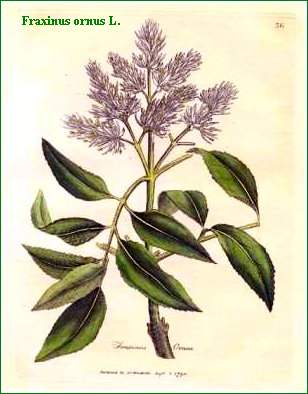
The dried saccharine juice exuded from the stems of the European flowering ash, Fraxinus ornus
(Oleaceae), usually containing from 40 to 60% of mannitol.
Foreign Pharmacopeias: In Belg., Dan., Fr., Ger.,
Hung,, Jug., Nor., Span., Swed., and Swiss. Jug. specifies not less than 72-5% of mannitol,
Hung, and Nor. not less than 75%.
Flake
manna, which is the best variety, occurs as yellowish-white, brittle, stalactitic
masses about 10 to 15 cm. long and about 2 to 2-5 cm. wide, with a
slight agreeable odour and a sweet taste. Inferior qualities (small or
broken manna) consist of agglutinated fragments and are usually darker
in colour and more glutinous. Soluble 1 in 5 of water and 1 in 150 of alcohol (90%).
Uses.
Manna has mild laxative properties but it sometimes causes flatulence
and griping. It has been employed as a laxative for infants and
children. A syrup (1 in 10) has been used.
A hexahydric alcohol closely related to the hexose
sugars; it is isomeric with sorbitol. It occurs as a white odourless
crystalline powder with a sweetish taste.
Soluble 1 in 6 of water, 1 in 85 of alcohol, 1 in 18 of glycerin,
and 1 in 3 of pyridine; insoluble in ether; soluble in aniline and in
solutions of alkali carbonates and hydroxides. Solutions are sterilised
by autoclaving or by filtration.
Uses.
Mannitol has diuretic properties. It has
also been used in the same way as inulin, in a test for renal function
(see Vol. II) but as about 10% is reabsorbed by the tubules, the
validity of the results is doubtful. The daily diuretic dose is 50 to 100 g. administered intravenously
as a 25% solution. It is also used as a diluent and excipient in
pharmaceutical preparations.
A hexahydric alcohol closely related to the hexose
sugars. It occurs naturally, in small quantities, in apples, cherries,
pears, plums, mountain-ash berries, and other fruits, and it is prepared
commercially by the catalytic hydrogenation of glucose. It is isomeric
with mannitol.
A white odourless crystalline powder with a sweet taste. Very soluble in
water and hot alcohol; sparingly soluble in cold alcohol.
Uses.
Since it does not produce a rise in blood sugar when taken by mouth, it
may be used by diabetics, in a daily dose of 30 to 80 g., in place of
sucrose. Soibitol may be used as a
substitute for glycerin in pharmaceutical preparations.
Editors
Note. propylene glycol ** is
extremely toxic and destroys brain cells.
Sorbitol
Solution (U.S.N.F.).
A clear colourless syrupy liquid with a sweet taste, containing 70% w/v
of total solids consisting essentially of D-sorbitol, together with a
small amount of mannitol and other isomeric
polyhydric alcohols. It contains not less than 64% w/v of D-sorbitol. Wt
per ml. about 1 -28 g. It is neutral to litmus. Miscible with water,
glycerin, and propylene glycol; slightly soluble in alcohol; almost
insoluble in most other organic solvents.
Foreign Pharmacopoeias: In all pharmacopoeias
examined.
Colourless odourless crystals, crystalline masses, or white powder, with
a sweet taste, obtained from the juice of the sugar cane or of the sugar
beet.
Uses.
Sucrose
is used as a sweetening agent and demulcent. If the sweetness of sucrose
is taken as 100, Laevulose
has a value of 173, dextrose 74, maltose 32, galactose 32, and lactose
16. Syrups prepared from concentrated solutions of sucrose form the
basis of many linctuses. Sucrose is also used as a lozenge basis. An
injection of 100 ml. of a 50% solution of sucrose is used by slow
intravenous drip in the treatment of cerebral oedema or to decrease
intra-ocular tension in glaucoma; there is some danger of kidney damage,
especially if the injection is repeated.
Uses.
Solutions of invert sugar have been used in the injection treatment of
varicose veins, and are stated to have the advantage of not causing
cramp or sloughing if accidentally injected outside the vein. 5 to 20
ml. of a 60 to 75 % w/v solution of invert sugar has been given.
A
thick, but free-flowing, dark brown liquid, prepared by heating sucrose
at 180� to 200�, and diluting to the required standard with water. Wt
per ml. 1-37 to 1-41 g.
Uses.
Burnt sugar is used as a colouring agent, usually as Solution of Burnt
Sugar, 10 m. of which will give a suitable colour to 1 fl. oz. of most
liquid preparations.
Caramel
of commerce is made from many raw materials, including sucrose, glucose,
liquid glucose, molasses, and invert sugar. It is supplied in various
qualities and strengths, with different colour intensities, to suit the
various commodities in which it is used.
Uses.
As maltodextrin is more readily digested
than starch, it is used in infants' foods, and in place of foods
containing starch when carbohydrate digestion is impaired. It is used in
infant feeding in place of lactose for adjusting the carbohydrate
content of diluted cows' milk to that of human milk.
Dextrin-Maltose
(Alien & Hanburys). A starch-free
mixture of carbohydrates for the modification of cows' milk in infant
and invalid feeding. Available in two forms: plain, and with sodium
chloride 2%.
Foreign Pharmacopoeias: In Belg., Egyp.,
Fr., Pol., Span., Swiss, and U.S.
White
odourless or almost odourless crystals or crystalline powder with an
intensely sweet taste. Solutions in water are acid to litmus.
Soluble
1 in 290 of water, 1 in 25 of boiling water, 1 in 12 of acetone, 1 in 30
of alcohol, and 1 in 50 of glycerin; slightly soluble in chloroform and
ether; very soluble in dilute solution of ammonia and in solutions of
alkali hydroxides and, with the evolution of carbon dioxide,
bicarbonates.
Uses.
Saccharin is used as a sweetening agent, and as a substitute for sucrose
in diabetes, obesity, and generally where the use of sucrose is
undesirable. It has no food value. It is commonly employed in the form
of saccharin sodium; the average amount required is about 1/20 gr. in
each fl. oz. or about 1 in 10,000.
Saccharin
is usually considered to have about 550 times the sweetening power of
sucrose, but this depends to some extent on the strength of solution
used, the relative sweetening power being greatest in dilute solution.
Pharmacological, toxicological and clinical investigations have
confirmed the fact that saccharin is a completely harmless substitute***
for sugar even when used continuously.
1� to 3 gr. of saccharin is sufficient to replace the whole of
the sugar required by an adult for daily sweetening of food and drink,
i.e. 50 to 57 g .� H.
Staub and R. Staehelin,
Med. Pr., 1936, 193,419.
Experiments in vitro snowed saccharin to have an antiprothrombin
effect, but ingestion of saccharin in amounts above those obtaining in
ordinary dietary use was found to be without effect on the prothrombin
time. There is stated to be no synergism or antagonism between saccharin
and dicoumarol.� R.
D. Barnard, J. Amer. pharm. Ass., Sci.
Edn, 1947, 36, 225.
Editors
Note: *** This has been proven to be
incorrect.
Saccharin
Sodium (B.P.).
Saccharin. Sod.; Sodium Benzosulphimide;
Soluble Gluside; Soluble Saccharin. C7H4O3NSNa,2H2O
= 241-2.
Foreign Pharmacopoeias: In Chil.,
Chin., Cz., Dan., Egyp.,
Ger., Hung., Ind., Jap., Jug., Mex., Nor., Span., Swed., Swiss, and U.S.
A white odourless or almost odourless crystalline powder with an
intensely sweet taste. Soluble 1 in 1-5 of water and 1 in 50 of alcohol.
Solutions are sterilised by autoclaving.
Uses.
Saccharin sodium is used for the same purposes as saccharin, usually as
tablets or solution. It is also used to determine the arm-to-tongue
circulation time in patients with cardiac disease. A solution of 2-5 g.
in 4 ml. of warm water is rapidly injected into the median basilic
vein of the arm held level with the heart, and the time-lapse between
the injection and the first perception of a sweet taste in the mouth is
noted. In normal persons this circulation time is 9 to 16 seconds, but
in the presence of severe cardiac failure it may exceed 45 seconds.
Tablets
of Saccharin (B.P.C.). Tab. Saccharin. Prepared from a mixture of
saccharin and sodium bicarbonate or from saccharin sodium. Unless
otherwise specified, tablets each containing the equivalent of
1/5 grain of saccharin are supplied.
Saxin (Burroughs Wellcome).
Saccharin sodium, available as tablets each equivalent in sweetening
power to about 1 teaspoonful of granulated sugar.
A
white, almost odourless, crystalline powder with a very sweet taste.
Readily soluble in water; almost insoluble in alcohol, benzene,
chloroform, and ether. A 10% solution in water has a pH of 5 '5 to 7-5.
Uses.
It is used in place of sodium cyclamate when sodium intake must be
restricted.
Uses,
Sodium cyclamate is a sweetening agent used as a substitute for sucrose
by diabetics and patients on a restricted carbohydrate diet. It should
not be given to patients with renal damage, or those on a low salt diet.
It is about 30 times as sweet as sucrose. It is stable in hot solutions,
and is free from bitter after-taste in concentrations below 0-8%. An
excessive intake may produce a laxative effect and this should be
controlled by regulating the amount used in the diet.
Foreign Pharmacopeias: In Ger., Jap,, and Span.
Lustrous
colourless crystals or a white crystalline powder with a very sweet
taste. Soluble 1 in 800 of water, 1 in 50 of boiling water, and 1 in 25
of alcohol.
Uses.
It is used as a substitute for sucrose, being about 250 times as sweet.
Dulcin in quantities likely to be consumed is
harmless. No ill-effect has been observed in people consuming 25 dulcin
tablets (each 60 mg.) daily over a period of some months.� J. M. Dyson, Lancet, ii/1942, 141.
The
use of dulcin is being discouraged by the
U.S. Food and Drug Administration since it has been found to cause
injury to rats when fed at relatively low levels during 2-year tests.�
Mfg Chem., 1950, 21, 182.
