
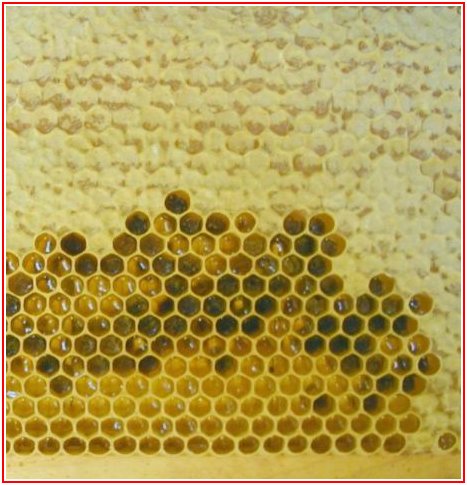
 HONEY.
United States Dispensatory 21st Ed. 1926.
Introduction by
Ivor Hughes
Honey, was before recorded
history. Every civilisation from East to West have utilised honey for it's
properties. It is nutrient and healing. It is used externally or taken
internally.
The bee honey precursor, is flower nectar.
The nectar of course is the food
lure for bees, butterflies, various insects and other pollinators. The composition of
nectar from the plants will vary. For example nectar taken from those
flowers that use a bird as the pollinator tends to be lower in organic
acids, than from those which are preferred by the insects.
The composition will also vary from location to location and from flower
specie to flower specie. Honey that has been gathered from chemically
sprayed crops will also contain traces of the poisons sprayed on them
in the same way as all scientifically raised food. (Chemical Farming)
Honey from bees that have been fed on sugar water is deficient in vital
trace elements and nutrients and as such is inferior, and is to all
intents and purposes an artificial product lacking in health giving
properties. This is common sense, apart from minor changes, the honey
secreted by the bee is essentially an inspissated nectar. Raw honey is
superior in everyway to heated honey, in that it will contain live enzymes.
Heat treatment will destroy the enzymes.
Raw honey is rich in both enzymatic and non-enzymatic antioxidants,
including catalase, ascorbic acid, flavonoids. A unique flavonoid,
pinocembrin, is present in high quantities in propolis and honey. Other
flavonoids found in honey are pinobanksin, chrysin, galangin, quercetin, Its
anti-microbial properties are prodigious, as are its wound healing. It has
proved useful in burns and sunburn.
Vitamins found in Honey.
Thiamin, Riboflavin, Niacin, Pantothenic acid, Vitamin B-6, Vitamin B-12,
Folate, Vitamin C, Vitamin A, Vitamin D, Vitamin E, Vitamin K.
Minerals in Honey.
Calcium, Copper, Iron, Magnesium. Manganese, Phosphorous, Potassium, Sodium,
Zinc.
Genetically Modified Plants
and Pollen.
It should be clearly understood that the introduction of this type of
totally irresponsible (GM) science which is totally devoid of any ethics or
common sense and is a catastrophe waiting to happen. The bee along with the
other pollinators is a vital link in our food crops. If they go down then we
all go down. Famine awaits in the wings. Pun intended!
MEL. U.S.
HONEY (Mel Depuratum, US. IX, Clarified Honey)
A saccharine substance, gathered mostly from the nectar of flowers, and
deposited in the honeycomb by the bee, .Apis mellifera Linne (Fam. Apidae.)
It must be free from foreign substances such as parts of insects,
leaves, etc. U.S.
Purified Honey is honey of
commerce melted and strained, the specific gravity, if necessary,
being adjusted to 1.36 by the addition of Distilled Water.
Mel Depuratum. Br;
Purified Honey; Mel Depuratum. Miel, Fr. Cod.; Mel, P. G.; Honig. G.;
Mlele, It.; Miel, Sp.
The U. S. IX recognized two forms of honey; the commercial substance and one
purified by dissolving in water, adding shredded paper pulp and filtering
and evaporating the water, and adding glycerin to prevent crystallization.
The improvement in the commercial article has made unnecessary the process
of purification and the present revision agrees with the Br. in describing
only one although under a different title. From the nectaries of various
flowers, the bee and other insects extract a thin, aqueous fluid,
nearly without flavor and insipidly sweet, usually known as nectar.
As honey is made out of this substance it is very much affected by the
character of the nectar, so that the nature of the plants which predominate
in the vicinity of the hive is a matter of great importance to the bee
culturist, not only in regard to the flavor of the honey which is
yielded, but even to its freedom from poisonous qualities, cases
having been reported from time to time of poisoning produced by the
eating of honey which had not been tampered with after extraction from the
hive.
In the United States honey made by the bee from the flowers of the Mountain
Laurel (Kalmia) is especially poisonous. See N.J.M.R., 1852, 46
((Poisonous Honey," by L. F. Kebler, Proc. A. Ph. A., 1896, 167; H. Bley,
Ph. Ztg., Nov., 1885. The latter states that Datura Stramonium and
Gelsemium are for honey making especially dangerous plants. The nectar
when taken in by the bee is chemically changed by secretions from
glands in the head and thorax; levulose, dextrose, and, rarely,
sucrose being formed.
The finest honey is that which is allowed to drain from the comb. As beeswax
is a valuable product in itself, modern centrifugal extractors are now
employed by apiculturists to separate the honey from the comb, after
cleanly slicing off the ends of the cells with a sharp knife.
Centrifuged honey is much cleaner than that produced by other methods.
If obtained from hives that have never swarmed, it is calIed virgin
honey. An inferior kind is procured by submitting the comb to
pressure, and if heat be employed previous to expression, the product is
still more impure.
The honey which is most highly esteemed is that made from the nectar of the
white clover blossom. Equally valuable is the honey derived from raspberry
blossoms and bass-wood flowers. The honey made late in the summer from the
flowers of the buckwheat is darker in color. The largest producer of honey
in the United States is California:.The United States is said to be
the greatest honey producing region on the globe, the annual production
being between 60,000,000 and 75,000,000 pounds. Nearly 2,000,000
pounds of wax are also produced in this country. The former method for
clarifying honey was as follows
Honey, a convenient quantity, Distilled Water, Glycerin, each, a sufficient
quantity. Weigh the honey in a tared dish, mix it intimately with two per
cent. of paper pulp, which has been previously reduced to shreds, thoroughly
washed and soaked in water, and then strongly expressed and again
shredded. Then heat on a water bath at a temperature not exceeding 70*
C., and carefully remove the scum which rises to the surface. Add
enough distilled water to make up the loss incurred by evaporation, strain,
and mix the strained liquid with five per cent. of its weight of
glycerin." U. S . For other methods of clarification, see U.S.D., 20th
ed., p. 691.
In the recent state honey is fluid, but on being kept it is apt to form a
crystalline deposit, and to be ultimately converted into a soft granular
mass. In commerce: it is found in every consistence, from that of a
viscid liquid, like thin syrup or oil, to that of lard or soft suet.
Its: color is sometimes white, but usually yellowish, and occasionally of a
brownish or reddish tinge. It has a peculiar agreeable odor, varying
somewhat with the flowers from which it was collected, and a very
sweet, feebly aromatic taste, which is followed by a slight prickling
or sense of acridity in the fauces. Cold water dissolves it readily,
alcohol with less facility.
Description and Physical
Properties.
A thick, syrupy liquid of a light yellowish or yellowish-brown color. It is
translucent when fresh, but frequently becomes opaque and granular from
crystallization of dextrose. It has a characteristic odor and a sweet,
faintly acrid taste. Honey is levorotatory at 200 C., and is slightly
acid to litmus paper. Diluted with twice its weight of water, Honey is only
moderately turbid, is not stringy, and has a specific gravity of not
less than 1.099 at 25 C.
Incinerate about 2 Gm. of Honey, accurately weighed, at a low temperature in
a platinum crucible, in small portions at a time: not more than 0.3 per
cent. of ash remains. A solution of 10 Gm. of Honey in 50 cc. of
distilled water requires not more than 0..5 cc. of normal sodium
hydroxide for neutralization, phenolphthalein T.S. being used as
indicator. Ten cc. portions of a filtered aqueous solution of Honey (1
in 10) show no more chloride than corresponds to 0;2 CC. of
fiftieth-normal hydrochloric acid and no more sulphate than
corresponds to 0.2 cc. of fiftieth- normal sulphuric acid, page 462. Boil
about 2 Gm. of Honey with 20 cc. of water, cool, and add 2 drops of
iodine T.S. no blue, green, or reddish color is produced (starch or
dextrins). The color of an aqueous solution of Honey (1 in 2) is not
immediately changed when mixed with an equal volume of ammonia T.S.
(foreign coloring matter), and a 5 cc. portion does not at once
acquire a red or rose color on the addition of a few drops of
hydrochloric acid (azo dyes) .Triturate about 1 Gm. of Honey with 20 cc. of
ether in a mortar, filter into a porcelain dish or crucible, allow the ether
to evaporate, and add to the residue one drop of resorcinol T.S. At
most only a pink color is produced, which disappears in half a minute,
but not an orange, cherry, or brown-red color (artificial honey or
added invert sugar) U.S.
The British Pharm. describes it as "a syrupy, translucent, pale yellowish
liquid. Aromatic odor; taste at first sweet, afterwards faintly acrid.
Specific gravity 1.36. Optical rotation at 15.5 C. of a solution in
water, containing 25 grammes in 100 millilitres, decolorised by
filtration with animal charcoal, in a tube 200 millimetres long,
between 0 and -5 C."
5 millilitres of the same solution when fixed with 15 millilitres of
absolute alcohol do not become more than faintly opalescent ( absence
of starch sugar). When 2 grammes are dissolved in 20 millilitres of
boiling water and cooled, the solution does not become blue on the
addition of one drop of N/10 solution of iodine (absence of starch)
.Ash not more than 0.25 per cent solution of the ash in water is not
alkaline to litmus, and when acidified with nitric acid yields not more than
a very faint opalescence with solution of barium chloride, or with
solution of silver nitrate (limit of sulphates and of chlorIdes)
Genuine honey varies somewhat in its composition.The principal constituents
are a mixture or dextrose and levulose in the same proportions as present in
artificial invert sugar and in an amount ranging from 65 percent to nearly
80 percent. Sucrose is present in from 0.5 per cent; to 8 per cent. The ash
of honey varies from 0.3 percent. to 0,50 per cent. and the water from
12 percent. to 33 per cent. In a standard honey the sucrose should not
be over 8 per cent., the water not over 25 percent. nor the ash over
0.25 per cent. Honeys obtained by bees feeding upon the saccharine
exudations of coniferous trees have been found to contain dextrose as
the preponderating sugar and to have a dextrorotatory optical rotation
instead of levorotatory , as in the ordinary varieties. Such honeys
usually come from foreign countries, although several specimens have been
reported from the western part of the United States, and one specimen
containing melezitose was reported from Pennsylvania, this rare
carbohydrate having originated as an exudation on the twigs of Pinus
virginiana. According to Wm..A. Selser, who separated wax from honey
on a large scale, the proportion of wax in the honey comb averages 1 per
cent from 1500 pounds he obtained 14.25 pounds of wax by actual
experiment. (A. J.P., 1904,267.) A large number of samples of genuine honey
analyzed in 1897 for the Department of Inland Revenue, Canada;
(Bull. 47) , showed the following variation;
Direct polarization, -2.4 to -19.
Invert polarization, -10.2 to -28.
Sucrose (by Clerget), 0.5to 7.64 per cent.
Invert sugar, 60.37 to 78.8 per cent.
Water, 12 to 33 per cent.
Ash, 0.03 to 0.50 per cent.
Neufeld in Der Nahrungsmittelchemiker als Sachsverstandiger, Berlin,
1907, p. 275, gives the following limits for pure honey of European
origin:
Water , 8.30 to 33.59 per cent.
Protein , 0.03 to 2.67 per cent.
Invert sugar. ...49.59 to 93.96 per ,cent.
Sucrose 0.10 to 10.12 per cent.
Dextrin 0.99 to 9.70 per cent.
Formic acid. ...0.03 to 0;21 per cent.
Ash 0.02 to 0.68 per cent.
Browne has published a comprehensive article on American honey (U. S. Dept.
Agric. Bur. of Chem., Bull. 110, 1908) of which the tabular analyses are
given in Leach, (( Food Inspection and Analysis," 3d ed., p. 635,
Kunnmann and Hilger (A.J.P.1896, 570) state that dextrin is present in
all honey, whether dextrorotatory or levorotatory, and claim to have
identified it as achroo-dextrin. Mullenhoff believes that the honey is
preserved in the sealed cells of the comb by the secretion with it of
a minute quantity of formic acid, and has found by experiment that the
addition of one part of 25 per cent. formic acid is sufficient to keep
permanently 250 parts of honey, but in this connection it should be
remembered that the absence of contact with the air would account for
the preservation of honey in the comb. Honey is sometimes adulterated with
artificial glucose. This cannot be detected by the official tests with
certainty, but the safest method is to employ the polariscope.
( See Leach, in Food Inspection and Analysis.)
According to Oscar Haenle, glucose can also be detected by first dialyzing
thoroughly and then polarizing, under which circumstance, if glucose be
present, rotation to the right occurs if the honey be pure the light
is not affected. Undialyzed honey ordinarily polarizes to the left,
but unadulterated conifer honeys are dextrogyrate. (P.J. xxi.) Honey
has been frequently adulterated with artificial invert sugar. This is best
detected by the official method given above.
Uses : Honey is a valuable foodstuff; not only
on account of its characteristic flavor but chiefly because it consists
largely of invert sugar, and is therefore more rapidly absorbed, it is often
more acceptable to the stomach than cane sugar. In medicine it is
sometimes used as a flavoring agent especially for gargles. Its
recognition by the Pharmacopeia, however, is because of its employent
in certain pharmaceutical processes, especially in the preparation of
blue mass.
Dose.
one to four fluidrachms (3.75 -15
cc.)
Off. Prep.
Confectlo Piperis. Br. Mel Boracis,
Br. Mel Rosae, US.. Oxymel, Br. Confectio Rosae, N.F.; Mel Sodii Boratis,
N.F.
