
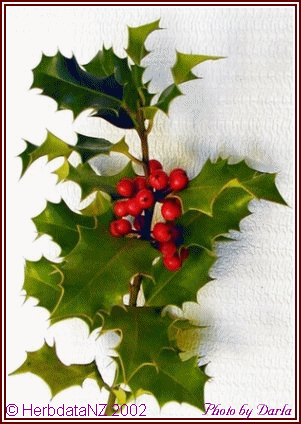
 Holly
Holly
Ilex
aquifolium L.
Compiled
and edited by Ivor Hughes.
1.
A Modern Herbal by Mrs. M. Grieve F.R.H.S.
2. The
United States Dispensatory. 21st Edition 1926.
3.
Boerickes
Homoeopathic Materia Medica
1. A Modern Herbal by Mrs. M. Grieve F.R.H.S.
Common Name : Holly
Nat Ord : Aquifoliaceae
Synonyms :
Hulver Bush. Holm. Hulm. Holme
Chase, Holy Tree, Christmas Holly, Christ's Thorn
Parts Used : Leaves, berries, bark.
Habitat : The Holly
is a native of most of the central and southern parts of Europe. It
grows very slowly: when planted among trees which are not more rapid
in growth than itself, it is sometimes drawn up to a height of 50
feet, but more frequently its greatest height in this country is 30 to 40
feet, and it rarely exceeds 2 feet in diameter. In Italy and in the woods of
France, especially in Brittany, it attains a much larger size than is common
in these islands.
History : Holly, the most important of the
English evergreens, forming one of the most striking objects in the
wintry woodland, with its glossy leaves and clusters of brilliant
scarlet berries, is in the general mind closely connected with the
festivities of Christmas, having been from very early days in the
history of these islands gathered in great quantities for Yuletide
decorations, both of the Church and of the home. The old Christmas
Carols are full of allusions to Holly:
Christmas decorations are
said to be derived from a custom observed by the Romans of sending
boughs, accompanied by other gifts, to their friends during the
festival of the Saturnalia, a custom the early Christians adopted. In
confirmation of this opinion, a subsequent edict of the Church of
Bracara has been quoted, forbidding Christians to decorate their houses at
Christmas with green boughs at the same time as the pagans, the Saturnalia
commencing about a week before Christmas. The origin has also been traced to
the Druids, who decorated their huts with evergreens during winter as
an abode for the sylvan spirits. In old church calendars we find
Christmas Eve marked templa exornantur (churches are decked), and the
custom is as deeply rooted in modern times as in either pagan or early
Christian days.
An old legend declares that the Holly first sprang up under the footsteps of
Christ, when He trod the earth, and its thorny leaves and scarlet berries,
like drops of blood, have been thought symbolical of the Saviour's
sufferings, for which reason the tree is called 'Christ's Thorn' in
the languages of the northern countries of Europe. It is, perhaps, in
connection with these legends that the tree was called the Holy Tree,
as it is generally named by our older writers. Turner, for instance,
refers to it by this name in his Herbal published in 1568. Other
popular names for it are Hulver and Holme, and it is still called
Hulver in Norfolk, and Holme in Devon, and Holme Chase in one part of
Dartmoor.
Pliny describes the Holly under the name of Aquifolius, needle leaf, and
adds that it was the same tree called by Theophrastus Crataegus, but
later commentators deny this. Pliny tells us that Holly if planted near a
house or farm, repelled poison, and defended it from lightning and
witchcraft, that the flowers cause water to freeze, and that the wood,
if thrown at any animal, even without touching it, had the property of
compelling the animal to return and lie down by it.
In May, the Holly bears in the axils of the leaves, crowded, small,
whitish flowers, male and female flowers being usually borne on
different trees. The fertile flowers are succeeded by the familiar,
brilliant, coral-red berries. The same tree rarely produces abundant crops
of flowers in consecutive seasons, and Hollies sometimes produce
abundance of flowers, but never mature berries, this barrenness being
caused by the male flowers alone being properly developed. Berries are
rarely produced abundantly when the tree is much clipped, and are
usually found in the greatest number on the upper part of the tree,
where the leaves are less spiny.
The berries, though eaten by birds, are injurious to human beings, and
children should be warned against them. Deer will eat the leaves in
winter, and sheep thrive on them. They are infested with few insects.
The ease with which
Holly can be kept trimmed renders it valuable as a hedge plant: it
forms hedges of great thickness that are quite impenetrable.
It has been stated by M. J. Pierre, that the young stems are gathered in
Morbihan by the peasants, and made use of as a cattle-food from the end of
November until April, with great success. The stems are dried, and having
been bruised are given as food to cows three times daily. They are
found to be very wholesome and productive of good milk, and the butter
made from it is excellent.
It is also well known to rabbit-breeders that a Holly-stick placed in a
hutch for the rabbits to gnaw, will act as a tonic, and restore their
appetite.
The wood of Holly is hard, compact and of a remarkable even substance
throughout. Except towards the centre of very old trees, it is beautifully
white, and being susceptible of a very high polish, is much prized for
ornamental ware, being extensively used for inlaying, as in the so-called
Tunbridge ware. The evenness of its grain makes it very valuable to the
turner. When freshly cut, it is of a slightly greenish hue, but soon
becomes perfectly white, and its hardness makes it superior to any
other white wood. As it is very retentive of its sap and warps in
consequence, it requires to be well dried and seasoned before being
used. It is often stained blue, green, red or black; when of the
latter colour, its principal use is as a substitute for ebony, as in the
handles of metal teapots. Mathematical instruments are made of it, also the
blocks for calico printing, and it has been employed in wood engraving as a
substitute for boxwood, to which, however, it is inferior. The wood of the
silver-striped variety is said to be whiter than that of the common kind.
A straight Holly-stick is much prized for the stocks of light driving whips,
also for walking-sticks.
Part Used :The
leaves and berries, also the bark. The leaves are used both fresh and
dried, but usually in the dried condition, for which they are collected in
May and June. They should be stripped off the tree on a dry day, the
best time being about noon, when there is no longer any trace of dew
on them. All stained or insect-eaten leaves must be rejected.
Medicinal Action and Uses :Holly leaves were formerly used as a diaphoretic and
an infusion of them was given in catarrh, pleurisy and smallpox. They
have also been used in intermittent fevers and rheumatism for their
febrifugal and tonic properties, and powdered, or taken in infusion or
decoction, have been employed with success where Cinchona has failed,
their virtue being said to depend on a bitter principle, an alkaloid
named Ilicin. The juice of the fresh leaves has been employed with advantage
in jaundice.
The berries possess totally different qualities to the leaves, being
violently emetic and purgative, a very few occasioning excessive vomiting
soon after they are swallowed, though thrushes and blackbirds eat them
with impunity. They have been employed in dropsy; also, in powder, as
an astringent to check bleeding.
Culpepper says 'the bark and leaves are good used as fomentations for broken
bones and such members as are out of joint.' He considered the berries to be
curative of colic.
From the bark, stripped from the young shoots and suffered to ferment,
birdlime is made. The bark is stripped off about midsummer and steeped in
clean water; then boiled till it separates into layers, when the inner
green portion is laid up in small heaps till fermentation ensues.
After about a fortnight has elapsed, it becomes converted into a
sticky, mucilaginous substance, and is pounded into a paste, washed
and laid by again to ferment. It is then mixed with some oily matter,
goosefat being preferred, and is ready for use. Very little, however,
is now made in this country. In the north of England, Holly was
formerly so abundant in the Lake District, that birdlime was made from it in
large quantities and shipped to the East Indies for destroying insects.
Adapted from : A Modern Herbal by Mrs
M. Grieve F.R.H.S.
2. The United States Dispensatory. 21st Edition 1926.
Ilex.
Holly. Houx, Fr. Stechpalme, Ohristdorn, G. Several species of Ilex (Fam. Aquifoliaceae) are employed in different parts of the world.I. Aquifolium L., or European Holly, is an evergreen tree growing to the height of 40 feet, but under cultivation is often shrubby. It has a pyramidal crown of short spreading branches which bear alternate, ovate or oblong-ovate, sinuate, spiny toothed, shining coriaceous leaves and globular, scarlet fruits. It is the most beautiful of all evergreens, but is unsuited to our climate, being too tender to withstand the winters in the northern States and equally affected by the hot, dry summers in the southern States. A viscid substance called birdlime is prepared from the inner bark (
see Viscum). The leaves, which are of a bitter, somewhat acrid taste, were formerly much esteemed as a diaphoretic, and in the form of infusion were employed in catarrh, pleurisy, small-pox, gout, etc. At one time they enjoyed a brief reputation in France as a cure for intermit-tents. They were used in powder, in the dose of a drachm two hours before the paroxysm, and this dose was sometimes repeated frequently during the apyrexia.Labourdais obtained an amorphous bitter principle which he called iliein from the leaves. (See A. J. P., xxi, 89.) Moldenhauer in 1857 separated a yellow coloring substance called iliaeanthin, and a peculiar acid called ilicic acid. Ilicic alcohol, C30H50O, was separated by Personne from birdlime and found to be identical with
ά-amyrin. (C. R. S. B., 1908, 862.) Ilixanthin is C17H22O11. It crystallizes in yellow needles, which change color at 185� C., melt at 198� C., and at 214� C. boil with decomposition, and are not sublimable.It is insoluble in ether, but soluble in alcohol. In cold water it is almost insoluble; but hot water dissolves it freely, and deposits it in crystals on cooling. The berries are about the size of a pea, red and bitter, and are said to be purgative, emetic, and diuretic. Ten or twelve of them will usually act on the bowels, and sometimes excite vomiting. Their expressed juice has been used in jaundice.
Ilex opaca
Ait., or American holly, is a
middling evergreen-tree attaining a height of 50 feet, growing throughout
the Atlantic section of the United States, and especially abundant in New
Jersey. It resembles European holly in many details but has less glossy
leaves and fruits. The berries, examined by D. P. Pancoast, were found to
contain tannin, pectin, two crystallizable organic principles, and salts
of potassium, calcium, and magnesium. One of the crystallizable principles
was inodorous and tasteless, the other inodorous but intensely bitter. The
latter is probably pure ilicin. (A. J. P., xxviii, 314.) Walter A. Smith
(A. J. P., 1887, 1668) obtained a resin soluble in alcohol by the ether
extraction, and in the portion of this soluble in water he obtained
evidences of a glucoside. This species is said to possess the same
medicinal properties as I. aquifolium L.
3.
Boerickes
Homoeopathic Materia Medica
ILEX AQUIFOLIUM. (American Holly)
Intermittent fever. Marked eye symptoms, spleen pain. All symptoms
better in winter.
Eye. infiltration of cornea; staphyloma; nightly burning in orbits, rheumatic inflammation of eye; psilosis.
Relationship. Ilex Paraguayensis. Yerba Mate. (Persistent epigastric pain; sense of dryness of mouth and pharynx, anorexia, pyrosis, nervous depression, neurasthenia. Somnolence; incapacity for work, diminution of urinary secretion, headache and pruritus. Hemicrania. Renal colic. Is said to be of use as a prophylactic against sunstroke, being a safe stimulant to the circulation, to diaphoresis and diuresis.)
Did you find what you were looking for? If not please use the site search box at the top right hand of the page or else return to the site library.
