
Monograph of the USD 1926.
Compiled and edited by Ivor Hughes.
Cinnamon is the dried bark of Cinnamomum Loureirii Nees. Fam. Lauracea.
Cinnamon yields not less than 2 per cent. of volatile ether soluble extractive, U.S. Cinnamon Bark is the dried inner bark of shoots from the truncated stocks of Cinnamomum zeylanicum, Breyn. Obtained from cultivated trees. Imported from Ceylon and distinguished in commerce as Ceylon cinnamon. Br. Cinnemomi Cortex. Br. Cinnamon Bark Cortex Cinnamomi. Cannelle Fr. Zimmt. G. Cannella. It Canela.Sp Kurundu.Cingalese Karua Puttay. Tamil
Both Cinnamomum and cassia were terms employed by the ancients, but
whether exactly as now understood it is impossible to determine. From
what source the ancients derived their cinnamon and cassia is not
certainly known. Neither the plants nor their localities, as described by
Dioscorides, Pliny, and Theophrastus, correspond precisely with our
present knowledge; but in this respect much allowance must be made for the
inaccurate geography of the ancients. It is probable that the Arabian
navigators at a very early period conveyed this spice within the
limits of the Phoenician and Grecian and subsequently of the Roman commerce.
The three principal varieties of cinnamon are known as Saigon Cinnamon,
Ceylon Cinnamon and Cassia Cinnamon. Of these the U. S. P. has favored
various ones in its previous editions. At present the U.S.P. recognizes only
the Saigon variety and the Br. Ph. only the Ceylon. The genus
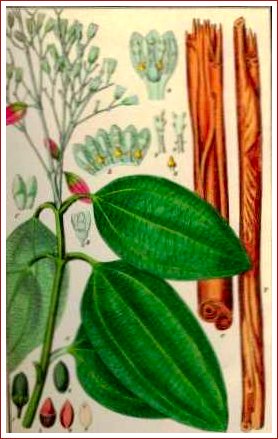
Cinnamomum is a group of evergreen trees with mostly three-nerved
leaves. The flowers which are either perfect or polygamous are of a pale
yellow color and borne in panicles. Cinnamomum loureirii (Nees) the
botanical source of Saigon Cinnamon, is of medium height, native to China
and Japan. Its branches are glabrous and bear opposite and alternate, rigid,
entire, elliptic to oblong, attenuate-acuminate leaves having
acoriaceous texture. The petioles of these are one-half inch or less
in length, the blades three to five inches long. The flowers are very small
and they were in the dried state, formerly an article of commerce under the
name of Flores Cassiae. The fruit is a berry which adheres to the
receptacle.
The Saigon cinnamon is collected chiefly from wild trees especially
in the mountainous districts of Annam, in French Indo China. .The greater
portion of it is from branches and small stems and of good quality,
although sometimes chips of the thick trunk bark are mixed with the quills.
This variety is called Saigon because it is exported from the city of
that name in the southern part of Cochin-China
Cinnamomum zeylandicum (Nees) is a native of Ceylon and the neighboring Malabar coast In the wild state it is a tree about 20 or 30 feet high, covered with a thick, scabrous bark. The branches are numerous, strong, horizontal, and declining, and the young shoots are beautifully speckled with dark green and light orange colors. The leaves are 4 to 7 inches long, petiolate, opposite for the most part, coriaceous, entire, ovate or ovate-oblong, obtusely pointed and three-nerved, with the lateral nerves vanishing as they approach the point. There are also two less obvious nerves, one on each side arising from the base, proceeding towards the border of the leaf and then quickly vanishing. In one variety the leaves are very broad and some what cordate. When mature, they are of a shining green upon their upper surface, and lighter-colored beneath.
The tree emits no odor perceptible at any distance. The bark of the root has the odor of cinnamon with the pungency of camphor, and yields this principle upon distillation. The leaves have a spicy odor when rubbed, and a hot taste. A volatile oil has been distilled from them. The petiole has the flavor of cinnamon. The flowers have a disagreeable, fetid odor. The fruit has a terebinthinate odor when opened, and a taste in some degree like that of juniper berries. A fatty substance, called cinnamon-suet, is obtained from it when ripe, by bruising it and then boiling it in water, and removing the oleaginous matter which rises to the surface and concretes upon cooling. The Ceylon cinnamon is produced chiefly from cultivated plants, the principal gardens being in the viainity; of Colombo. Here the plant is never allowed to become a tree but by vigorous cutting back is forced to produce a bushy growth of slender stems. The seeds are planted four or five in a hill and the first five or six years the stems are pruned to be straight, then cut down and by coppicing produce a new crop of shoots.
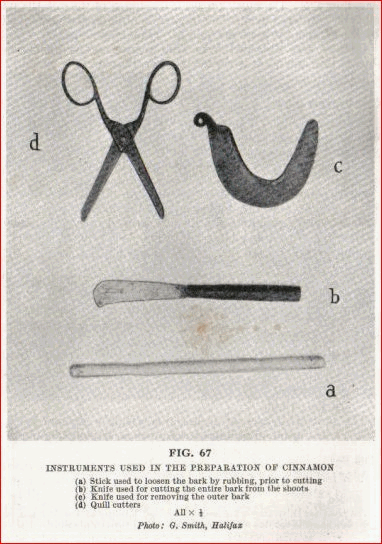 The
cinnamon harvest commences in May and continues until late in
October. Before decortication the shoots are trimmed up, and the
small pieces, when dried, constitute cinnamon chips. The bark is
divided by longitudinal incisions, of which two are made in the
smaller shootsr several in the larger, and is then removed in strips
by ,means of a suitable instrument. The pieces are next collected in
bundles, and allowed to remain in this state for a short time, so as
to undergo a degree of fermentation, which facilitates the separation
of the epidermis. This, with the green matter beneath it, is removed
by placing the strip of bark upon a convex piece of wood and scraping
its external surface with a curved knife.
The
cinnamon harvest commences in May and continues until late in
October. Before decortication the shoots are trimmed up, and the
small pieces, when dried, constitute cinnamon chips. The bark is
divided by longitudinal incisions, of which two are made in the
smaller shootsr several in the larger, and is then removed in strips
by ,means of a suitable instrument. The pieces are next collected in
bundles, and allowed to remain in this state for a short time, so as
to undergo a degree of fermentation, which facilitates the separation
of the epidermis. This, with the green matter beneath it, is removed
by placing the strip of bark upon a convex piece of wood and scraping
its external surface with a curved knife.The bark now dries and contracts, assuming the appearance of a quill. The peeler introduces the smaller tubes into the larger, and connects them also endwise, thus forming a congerics of quills which is about forty inches long. When sufficicntly dry, these cylinders are collected into bundles weighing about thirty pounds and bound together by pieces of split bamboo.
The c. zeylanicum is also cultivated to a limited extent in some of the West India islands, especially Martinique and Cayenne-- and in Brazil. The bark from this source is generally regarded as inferior to that from Ceylon; it is known commercially as Cayenne cinnamon. The commercial supplies are imported from Colombo ( Ceylon) and Calcutta (India).
Cinnamomum cassia (Nees) Blume is cultivated for the bark, buds and oil of cassia in the southeastern provinces of China. The bark after collection is scraped and dried. It is then made into bundles weighing from half to 1 kilo. which are tied with split bamboo, packed into bamboo cases ,vhich are then covered with bamboo mats. Very frequently these bundles contain chips and dirt in the center which are obscured from view by long quills on the outside. The commercial supplies of Cassia Cinnamon bark come from China and Calcutta, India. The poorer grades are known as Cassia lignea.
From this tree is derived the spice known as Cassia buds. This consists of the calyx surrounding the young ovary. Cassia buds have some resemblance to cloves, and are compared to small nails with round heads. The enclosed ovary is sometimes removed, and they are then cup-shaped at top. They have a brown color, and the flavor of cinnamon.
Did you find what you were looking for? If not use the site search box at
the top right hand of the page or return to the site library.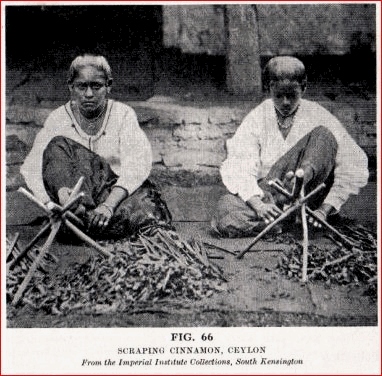 C.
iners Reinw. is
distinguished from C. zeylanicum by the nervation of its
leaves, which are also paler and thinner. It is probably only a variety, not
a distinct species. It yields the so-called wild cinnamon of Japan.
C. obtusifolium Nees, growing in Ceylon, Java, and on the mainland of
India, is said to have been the chief source of the drug known
formerly by the name of Folia Malabathri and consisting of the leaves of
different species of Cinnamomum mixed together. C. Culilawan Blume of
the Moluccas yields the aromatic bark called culilawan, noticed in
Part II of this work; and similar barks are obtained from C. Sintoc of
Java. Massoy bark, from which an aromatic volatile oil is obtained
called oil of massoy, is the product of Sassafras Goesianum Leijom. In
the mountains of Eastern Bengal, at a height of 1000 to 4000 feet,
flourish C. obtusifolium Nees, C. pauciflorum Nees, and C. Tamala Nees
et Ebern., and these, with other unknown species, afford quantities of
bark which are shipped from Calcutta, Java, Timor, etc., to Europe
under the name of wild cassia. The bark of the C. pedatinervium
Meissn., a tree indigenous to Fiji, yields nearly one per cent.
of a white aromatic volatile oil, with a pungent spicy taste.
C.
iners Reinw. is
distinguished from C. zeylanicum by the nervation of its
leaves, which are also paler and thinner. It is probably only a variety, not
a distinct species. It yields the so-called wild cinnamon of Japan.
C. obtusifolium Nees, growing in Ceylon, Java, and on the mainland of
India, is said to have been the chief source of the drug known
formerly by the name of Folia Malabathri and consisting of the leaves of
different species of Cinnamomum mixed together. C. Culilawan Blume of
the Moluccas yields the aromatic bark called culilawan, noticed in
Part II of this work; and similar barks are obtained from C. Sintoc of
Java. Massoy bark, from which an aromatic volatile oil is obtained
called oil of massoy, is the product of Sassafras Goesianum Leijom. In
the mountains of Eastern Bengal, at a height of 1000 to 4000 feet,
flourish C. obtusifolium Nees, C. pauciflorum Nees, and C. Tamala Nees
et Ebern., and these, with other unknown species, afford quantities of
bark which are shipped from Calcutta, Java, Timor, etc., to Europe
under the name of wild cassia. The bark of the C. pedatinervium
Meissn., a tree indigenous to Fiji, yields nearly one per cent.
of a white aromatic volatile oil, with a pungent spicy taste.
For constitution, etc., see Proc. Chem. Soc., xix. These barks are
mostly highly aromatic, resembling cinnamon more or less closely in
flavor, and are distinguished by yielding to cold water an abundant
mucilage. Holmes described the bark of C. pedativum Meis., and
concludes that it might be of value as a source of safrol and linalool
in P. J., 1904, p. 892.
Description and Physical Properties. - Unground Cinnamon. In quills
up to 30 cm. long and 4cm. in diameter, the bark from 0.5 to 3.0 mm.
in thickness, or in broken irregular pieces or in flattened slabs up
to 8'mm. in thickness; the outer surface light brown to dark
purplish-brown, with grayish patches of crustose lichens and numerous
bud-scars, finely wrinkled when from young twigs, otherwise, more or less
rough from corky patches surrounding the lenticels; inner surface
reddish-brown to dark brown, granular and slightly striate; fracture
short; odor characteristic and aromatic; taste sweetish, aromatic and
pungent.
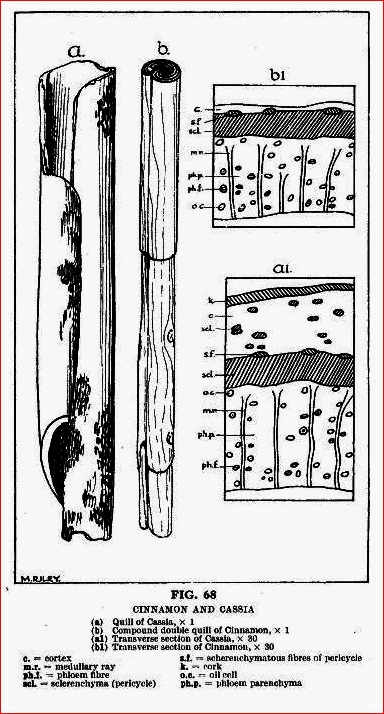 Structure.-A
narrow outer layer of more or less lignified cork cells followed by a
layer of starch-bearing parenchyma with scattered stone cells and a
nearly continuous zone of stone cells among which are small groups of
bast-fibers with thickened and slightly lignified walls ; inner bark
with medullary rays 1 to 3 cells wide, inconspicuous sieve tissue,
bast-fibers in groups of 2 to 20, mucilage and oil cells numerous and
about the size of the parenchyma cells; parenchyma cells usually
filled with starch or containing very small raphides of calcium
Oxalate the Lumina of parenchyma cells, stone cells and bast-fibers
frequently filled with an amorphous reddish-brown substance, which is
for the most part insoluble in the ordinary reagents. In the bark of
the young twigs there is an epidermal layer with a thick, yellowish cuticle,
fewer stone cells in the zone associated with bast-fibers, the inner bark
narrower and with fewer secretion cells than in the older bark.
Structure.-A
narrow outer layer of more or less lignified cork cells followed by a
layer of starch-bearing parenchyma with scattered stone cells and a
nearly continuous zone of stone cells among which are small groups of
bast-fibers with thickened and slightly lignified walls ; inner bark
with medullary rays 1 to 3 cells wide, inconspicuous sieve tissue,
bast-fibers in groups of 2 to 20, mucilage and oil cells numerous and
about the size of the parenchyma cells; parenchyma cells usually
filled with starch or containing very small raphides of calcium
Oxalate the Lumina of parenchyma cells, stone cells and bast-fibers
frequently filled with an amorphous reddish-brown substance, which is
for the most part insoluble in the ordinary reagents. In the bark of
the young twigs there is an epidermal layer with a thick, yellowish cuticle,
fewer stone cells in the zone associated with bast-fibers, the inner bark
narrower and with fewer secretion cells than in the older bark.
Powdered Cinnamon.-Yellowish-
or reddish-brown; starch grains numerous; single and 2- to 4-compound,
the single grains from 0.005 to 0.025 mm. in diameter; stone cells
irregular in shape, occasionally with one wall much thinner than the
other walls, sometimes containing starch; bast-fibers from 0.3 to 1.5 mm.
in length, with very thick and slightly lignified walls; parenchyma
cells with reddish-brown walls; oil cells and mucilage cells not
readily distinguishable.
Assay -
Proceed as directed under volatile ether-soluble extractive. Preserve
in tightly closed containers. U.S. According to Siebold, the
bark of the large branches is of inferior quality and is rejected ; that
from the smallest branches resembles the Ceylon cinnamon in thickness,
but has a very pungent taste and odor, and is little esteemed, while
the intermediate branches yield an excellent bark, about 2 mm. in
thickness, which is even more highly valued than the cinnamon of
Ceylon, and yields a sweeter and less pungent oil.
Ceylon cinnamon occurs in closely rolled quills, each about
nine millimeters in diameter, and containing numerous smaller quills
or channeled pieces. Dull, pale yellowish-brown, darker on the inner
surface; thin, brittle and splintery; entirely free from cork; marked
with small scars or holes and with faint, shining, wavy longitudinal
lines.
The powdered Bark
exhibits abundant parenchymatous tissue with brown cell-walls,
isolated bast-fibers not more than 30 microns in diameter, small
simple or compound starch grains and thick-walled sclerenchymatous cells,
but no cork or fragments of wood. Fragrant odor; taste warm; sweet and
aromatic.
Ash not
more than 5 per cent." Br. " Under the microscope, sections
of Ceylon Cinnamon usually show no cork but an almost continuous outer
layer of stohe cells, among which are small groups of bast-fibers
resembling those found in Saigon Cinnamon, in the inner bark occur
numerous bast-fibers singly or in small groups, medullary rays 1 to 2
cells in width, usually witb raphides of calcium oxalate; parenchyma
with either reddish-brown contents or more or less filled with starch
grains; scattered throughout the parenchyma occur oil secretion cells
and mucilage cells. The powder is light brown or yellowish-brown;
starch grains numerous, varying from spherical to polygonal, from
0.003 to 0.02 mm. in diameter, frequently in small aggregates;
bast-flbers from 0.3 to 0.8 mm. in length, usually single,
spindle-shaped, with attenuated ends, .the walls being very thick and
but slightly lignified; colorless stone cells resembling those of
Saigon Cinnamomi numerous cellular fragments with yellowish-brown
walls or contents; cork cells few or none; calcium oxalate in
raphides, from 0.005 to 0.008 mm. in length.
Ceylon Cinnamon yields
not less than 0.5 per cent of volatile extractive soluble in ether. U.S.IX.
When distilled Ceylon Cinnamon affords but a small quantity of essential
oil, which, however, has an exceedingly grateful flavor. It is brought
to this country from England, but it is costly. The inferior sorts are
browner, thicker, less splintery, and of a less agreeable flavor, and are
little if at all superior to the best Chinese.
The finer variety of Cayenne
cinnamon approaches in character that above described, but is paler and
in thicker pieces, being usually collected from older branches. That
which is gathered very young is scarcely distinguishable from the
cinnamon of Ceylon.
Chinese cinnamon, or
Cassia ( Cinnamomum Cassia, U. S., 1890) , occurs in quills, usually single,
sometimes double, very rarely more than double, from 30 to 60 cm.
long, 2 to 5 cm. wide, and 0.2 to 3 mm. thick. In some instances the
bark is rolled very much upon itself, in others is not even completely
quilled, forming segments more or less extensive of a hollow cylinder.
It is of a redder or darker color than the finest Ceylon cinnamon, thicker,
rougher, denser, and breaks with a shorter fracture. It has a
stronger, more pungent and astringent but less sweet and grateful
taste, and though of a similar odor, is less agreeably fragrant. It is
the kind almost universally kept in our shops. Under the name of
cassia have also been brought to us very inferior kinds of cinnamon,
collected from the trunks or large branches of the trees, or injured by want
of care in keeping, or perhaps derived from inferior species. It is
said that cinnamon from which the oil has been distilled is sometimes
fraudulently mixed with the genuine. These inferior kinds are
detected, independently by their greater thickness and coarseness of
fracture, by their deficiency in the peculiar sensible properties of
the spice. Chinese cinnamon is " in quills of varying length and
about 1 mm. or more in thickness ; nearly deprived of the corky layer,
yellowish-brown; outer surface somewhat rough; fracture nearly smooth;
odor fragrant; taste sweet, and warmly aromatic." U. S. 1890. Cassia
is no longer official in the U. S. P., it having been dropped at the
8th Revision.
Powdered cinnamon
is often grossly adulterated with sugar, ground walnut shells, galanga
rhizome and various other substances. Galanga, according to
Schmitz-Dumont, may be detected by the presence of small club-shaped,
rod-shaped, partly bent, microscopic pieces of resino-tannol. (Zeit.
oeff. Chem., 1903, No.2.) Powdered cassia buds are frequently added to
the inferior cinnamon powders, but can hardly be looked upon as an
adulterant, as they contain a larger proportion of volatile oil than
the lower grades of cinnamon.
The Pharmacopoeia gives the following tests
for distinguishing
powdered cassia from powdered cinnamon, and for recognizing the inferior
varieties of cassia. Make a decoction of powdered cinnamon of known
genuineness, and one of similar strength of the suspected powder; when
cool and strained, test a fluid ounce of each.with one or two drops of
tincture of iodine. A decoction of cinnamon is but little affected, but in
that of cassia a deep blue-black tint is immediately produced. The cheap
kinds of cassia known as cassia vera may be distinguished from the
more valuable Chinese cassia as well as from cinnamon by their
richness in mucilage; this can be extracted by cold water ; it is a
thick glairy liquid, giving dense ropy precipitates with corrosive sublimate
or neutral lead acetate, but not with alcohol. The coarser cassia
bark, or cassia lignea, usually has some of the external or corky
layer adherent to it, and always the parenchymatous mesophirenm or
middle bark, but the inner bark constitutes the chief mass. Isolated
bast fibers and thick-walled stone cells are scattered even through
the outer layers of a transverse section. In the middle zone they are
numerous, but do not form a coherent sclerenchymatous ring as in
Ceylon cinnamon. The innermost part of the bast shares the structural
character of cinnamon, with differences due to age, as, for instance ,the
greater development of the medullary rays.
Oil cells and mucilage cells are likewise distributed among the
parenchyma of the former. The finest cassia or Chinese cinnamon has the
three layers described in Ceylon cinnamon, but is distinguished by the
adherent outer parenchymatous and suberous layer. For an excellent
description of the microscopical structure of the commercial cinnamon
see Winton and Moeller, "The Microscopy of Vegetable Foods."
Spaeth gives the microscopical characteristics of the several kinds of
cinnamon, discusses the adulterants of powdered cinnamon and the means
of detection in Ph. Centralh., 1908, pp. 724, 729. Rosenthaler and
Reis give an excellent pharmacognostical study of .Seychelles Cinnamon
in B. P. G., 1909, p. 490.
The chief substitute and adulterant for both Saigon, and Cassia
barks within recent years has been the Fagot or Batavia cassia.
This bark is obtained from Cinnamomum Burmanni Blume, a tree native to
Java and probably other East India islands. It occurs mostly in double
quills that are scraped, up to 3 mm. thick, light-brown to reddish
externally, extremely mucilaginous and less aromatic than the other 3
main varieties.
The powdered bark, unlike the other cinnamon barks described, forms a
shiny mass in water and may also be distinguished from these by the
presence therein of tabular and prismatic crystals of calcium oxalate.
R. Windisch reports that in the case of nine samples of cinnamon bark,
which he examined, four yielded an ash, dark-brown in color, which was
shown to contain considerable iron. The ash in these samples varied
from 6 to 10 per cent. as compared with 2.11 per cent. in normal
samples. The addition was found to consist of iron ochre, from 6 to 10
per cent. of this material having been added. ( Ztsch. Unters. Nahr u.
Gennssm., 41, 1921, p. 78.)
Constituents.-Cinnamon bark contains from 0.5 to 1.0 per cent. of
a peculiar essential oil (see Oleum Cinnamomi), some gum; a coloring
matter and a tannin of the variety which gives blue-black precipitate
with ferric salts. Thornton (A. J. P., 1895, 400) has examined the
tannin of a. Cassia. He found it to amount to about 3.90 per cent., as
an average of three different determinations on different samples. He
found it impossible to extract the tannin by any one of several
methods tried, and concludes that it either has the phlobophene
(anhydride) character as it exists in the drug or acquires such
character when brought into contact with water. Bucholz found in 100
parts of cassia lignea 0.8 of volatile oil, 4.0 of resin, 14.6 of
gummy extractive (probably including tannin ), 64.3 of lignin and
bassorin, and 16.3 of water, including loss.
Assay.- As the therapeutic value of cinnamon depends upon the
volatile oil, of which the most important ingredient is cinnamic
aldehyde, Fellenberg (D.C. 1916, lx, 755) has suggested the assay of
cinnamon for this aldehyde by the following process: 1 Gm. of the
powdered bark is heated with 40 cc. of alcohol for ten miriutes in a flask
provided with a reflux condenser.
The alcohol is then distilled until about 30 cc. is obtained, when 100 cc.
of water is added to the flask and distillation continued until the
distillate measures 100 cc. ; 5 cc. of this distillate are mixed with
2 cc. of a 5 per cent. alcoholic solution of isobutyl alcohol and 3
cc. of 38 per cent alcohol. To this is added 20 cc. of concentrated
sulphuric acid and allowed to stand for forty five minutes. The color
produced is compared with that of a 2 per cent. solution of cinnamic
aldehyde in 38 per cent alcohol produced by the same method. He found
the proportion of cinnamic aldehyde in Ceylon cinnamon. to be from 1.3
to 1.8 per cent. and in Chinese cinnamon from 1,25 to 2.77 per cent.
For another method of assaying cinnamon see Lanten Schlager, A, Pharm.;
1918, cclvi, 87.
Uses.-Cinnamon is among the most grateful and efficient of the
aromatics. It is warm and cordial to the stomach, carminative,
distinctly astringent, and, like most other substances of this class, more
powerful as a local than as a general stimulant. .It is seldom
prescribed alone,. though, when given in powder or infusion, It will
sometimes allay nausea, check vomiting, and relieve flatulence. It is
chiefly used as an adjuvant, and enters into a great number of
official preparations. It is often employed in diarrhea, in connection
with chalk and astringents.
Dose, of powder, ten to twenty grains (0.65 to 1.3 Gm.)
Off. Prep.-
Aqua Cinnamomi, Br.; Pulvis Cinnamomi Compositus, Br. Pulvis Cretae
Aromaticus, N. F. Br. Tinctura Cadamomi Compositus, Br. Tinctura Cinnamomi,
N. F., Br.Tinctura Lavandula Composita, U.S., Br. Pulvis Aromaticus, U.S.
Tinctura Cardamomi Composita, U.S. Tinctura Lavandulae Composita, U.S.
Elixir Taraxaci Composita (from Tincture) N.F. Syrupus Cinnamomi, N.F.
Tinctura Aromatica, N.F.
Also see the Volatile
Oils.
