
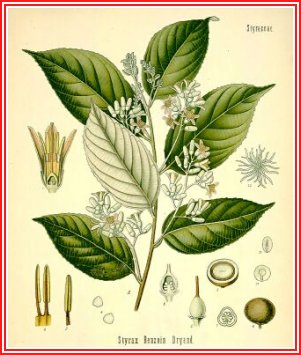
 Benzoinum
Monograph of the U.S.D. 1926.
Edited by
Ivor Hughes.
BENZOINUM. U.S.
Br.
BENZOIN Benzoin.
Benzoin is a balsamic
resin obtained from Styrax Benzoin Dryander and other species of Styrax
(Faro. Styracece), and known in commerce as Sumatra Benzoin and Siam Benzoin.
Sumatra Benzoin yields not less than 75 per cent. of alcohol-soluble
extractive and not more than 1 per cent. of acid-soluble ash.
Siam Benzoin yields not less than 90 per cent. of alcohol-soluble
extractive, contains not more than 1 per cent. of foreign organic matter,
and yields not more than 0.5 per cent. of acid-soluble ash. U.S.
Benzoin is a resinous solidified balsam obtained from the incised stem of
Styrax Benzoin Dryand. Known in commerce as Sumatra Benzoin." Br. Resina Benzoe, Asa
Dulcis: Gum Benjamin. Benfoin, Fr. Benzoe, P. G.; Benzoeharz, G.; Benzoino,
It.; Benjui, Sp.
It is generally believed that Siam
Benzoin is obtained from Styrax Benzoin Dryander. It appears to
closely resemble the tree growing in Sumatra, which yields 81 balsamic resin
bearing this name. Tschirch considers that the trees yielding Siam and
Sumatra Benzoin are physiological varieties of the same species. (Tschirch,
Harze, II. Aufl. p.195.) Rordorf (Schweiz. Apot.. Ztg.,1917) concludes
that the tree producing Siam Benzoin, while very similar to the S. Benzoin,
offers distinct differences and proposes a new species, S. siamensis (Rordorf.)
Strueff presents a careful morphological paper on the trees of Styrax
Benzoin, growing in Siam, Sumatra and Java, in A. Pharm., 1911, p. 10.
Styrax Benzoin, or Benjamin Tree, is a tall tree of quick growth, sending
off many strong round branches, covered with a whitish downy bark. Its
leaves are alternate, entire, oblong, pointed, smooth above and downy
beneath. The bowers are in compound, axillary clusters, nearly as long as
the leaves, and usually hang, all on the same side, upon short slender
pedicels.
The tree is a native of Sumatra, Java, Borneo, and other islands in the
vicinity. By wounding the bark near the origin of the lower branches, a
juice exudes, which hardens upon exposure and forms the Sumatra
Benzoin of Commerce. According to the researches of A. Tschirch (Journ.
Roy. Microscop. Soc., 1890), the exudation is purely the result of
pathological processes, the plant containing no resin receptacles.
The trees, which are either wild or cultivated, are deemed of a proper age
to be wounded at six years, when the trunks are usually about seven or
eight inches in diameter. The operation is performed annually, and the
product on each occasion from one tree never exceeds three pounds. The
juice which first .flows is the purest, and affords the whitest and most
fragrant benzoin.
The tree which yields the Siam Benzoin is not certainly determined.
According to E. M. Holmes its leaves are thinner and less distinctly
venated than those of the Styrax Benzoin. Hartwich believes it to be a
new species, Styrax benzoides Carib (see Kew Bulletin, 1912, p. 391). Holmes
(P. J., 1916) attributes it, however, to the S. tonkinense. Rordorf
(P. J.1917, xcix, p.111) received some fruits which were sent him from
Bangkok as specimens supposedly derived from the Benzoin tree; these
do not agree with any species previously described and he proposed a
new species, S. Siamensis Rordorf.
The territory from which the balsam is derived is a quite limited district
in the Province of Laung Probang along the River Mekong.
The Siam Benzoin
appears in commerce either in the form of separate tears or in masses
composed of tears cemented together by a rich amber-colored
translucent resin, these masses usually being in cubical blocks which take
their form from the wooden boxes in which the soft resin has been
packed. The tears are small, mostly less than 2 or 3 cm, in length,
opaque, brittle and milky white on the interior, but on keeping
gradually oxidize into the brownish translucent resin. The finest
variety is composed almost entirely of these tears, loosely
agglutinated together.
Sumatra Benzoin is sent into commerce chiefly from
Acheen in Sumatra. It differs from the Siam varieties in having a much
grayer color; the resin is grayish-brown, the tears are usually fewer than
in the finer variety, and the bits of wood, etc., more abundant. The
odor differs from, and is less agreeable than, that of Siam Benzoin.
Palenbang Benzoin resembles Sumatra Benzoin, but is
some what more transparent, and is stated to yield a larger percentage
of benzoic acid. It is also asserted that is can be distinguished by its
tincture, when dropped into water, not producing milkiness, but a
flocculent deposit.
Penang Benzoin also resembles Sumatra Benzoin, but
has an odor which is more like that of storax, and it is probably
yielded by the Styrax Benzoin; possibly it is the product of one of
the Sumatran species, S. subdenticulata Mig. For an account of the cultivation
and collection of benzoin in Sumatra, by L. M. Vonck, see C.D.,
1891,486-488; also D. C., 1891, 258. Ludy made an investigation of the
bark and wood of a benzoin tree which was brought from Java by
Tschirch. He reached the conclusion that benzoin balsam was produced from
the tannin of the bark. (A. Pharm., 1893, 43, 95.)
A variety of benzoin known as
Estoraque or Benjui, is produced in
Bolivia from the Styrax Pearcei Perk. var.
bolivianus. This has been shown by Wichmann (S. w. P., 1912, p. 237) to be
of similar composition to the Asiatic resin. According to this author resins
are also collected from a number of other species of Styrax in South America.
Properties.-Benzoin has a fragrant odor, with
very little taste, but when chewed for some time leaves a sense of
irritation in the mouth and fauces. It breaks with a resinous
fracture, and presents a mottled surface of white and brown or
reddish-brown ; the white spots being smooth and shining, while the
remainder, though sometimes shining and even translucent, is usually more or
less rough and porous, and often exhibits impurities. After long storage it
becomes covered with a thin yellow transparent film which Reinitzer finds is
due to oxidation of the proper resin (Schim. Rep., April,1915) .In the
inferior kinds the white spots are very few, or entirely wanting. Benzoin is
easily pulverized, and, in the process of being powdered, is apt to
excite sneezing.
Its sp. gr. is from
1.063 to 1.092. The U. S. Pharmacopeia
recognizes both Sumatra and Siam Benzoins. The official descriptions of
these follow:
Unground Sumatra Benzoin. Blocks or
lumps of varying size, made up of tears, compacted together with a
reddish-brown, reddish-gray, or grayish-brown resinous mass; tears
externally yellowish or rusty-brown, milky-white on fresh fracture; hard and
brittle at ordinary temperatures, but softened by heat and becoming
gritty on chewing;
odor aromatic. When
digested with boiling water the odor suggests cinnamic acid or storax;
taste aromatic and slightly acrid.
Unground Siam Benzoin. Pebble-like tears of variable size,
compressed, yellowish-brown to rusty-brown externally, milky-white on
fracture, separate or very slightly agglutinated, hard and brittle at
ordinary temperatures but softened by heat and becoming plastic on
chewing; odor agreeable, balsamic, vanilla-like;
taste aromatic and slightly acrid.
The solution of Benzoin in alcohol becomes milky
upon the addition of water and is acid to litmus paper, Heat a few
fragments of Benzoin in a test tube: Sumatra Benzoin evolves a sublimate consisting of plates and small,
rod-like crystals that strongly polarize light.
Siam Benzoin evolves a sublimate directly
above the melted mass consisting of numerous long, rod-shaped
crystals, which do not strongly polarize light. Treat about 0.25 Gm. of
Benzoin with 5 cc. of ether, decant about 1 cc. of the ethereal
solution into a porcelain dish, and add to it 2 or 3 drops of sulphuric
acid: the solution of Sumatra Benzoin produces a deep red-brown
coloration of the sulphuric acid and the solution of Siam Benzin
produces a deep purplish-red coloration.
Heat about 0.5 Gm. of Benzoinin a test tube with 10 cc. of potassium
permanganate T .S.: only the Sumatra variety develops in odor of
benzaldehyde. Treat about 1 Gm. of powdered Benzoin with 15 cc. of
warm carbon disulphide, filter, wash the filter with an additional 5
cc. of carbon disulphide, and allow the filtrate to evaporate
spontaneously: the residue does not exceed 12.5 per cent. This residue
responds to the tests for identity under
Acidum Benzoicum. Benzoin does not show the presence
of rosin.
Assay. Proceed as directed under
alcohol-soluble extractive. U.S.
Hard brittle masses consisting of numerous whitish tears embedded in a
greyish-brown translucent matrix. Odor agreeable, similar to that of storax;
taste slightly acrid; When cautiously heated in a dry test-tube it melts and
evolves whitish fumes with an irritating odor. When 0.5 gramme is slowly
heated to about 40 C. with 10 millilitres of solution of potassium
permanganate an odor of benzaldehyde is evolved (distinction from Siam
Benzoin). Not more than 15 per cent. insoluble in alcohol (90 per cent.). Ash not more than 5 per cent." Br.
When heated it melts, and emits thick, white, pungent fumes, which excite
coughing when inhaled, and consist chiefly of benzoic acid. It is wholly
soluble, with the exception of impurities, in alcohol, and is precipitated
by water from the solution, rendering the liquid milky. It yields to
boiling water a notable proportion of benzoic acid. Lime water and the
alkaline solutions partially dissolve it, forming benzoates, from
which the acid may be precipitated by the addition of other acids.
The percentage of alcohol-soluble matter require to be present by the U.S.P.
in benzoin is very high, and if rigidly enforced by the customs would
exclude Sumatra Benzoin in all but its very finest varieties. Robt. C.
Pursel and Willard Graham obtained from five commercial varieties of
Sumatra Benzoin, in the American market, an average of 86 per cent. of
soluble matter.
(Proc. Pennsylvania Pharm. .Assoc.,1902.) John Barclay, in England,
found the average of ten samples to be 69.9 per cent. (P. J., Jan.,
1903.) Benzoin retards the oxidation of fatty matters, and thus tends
to prevent rancidity.
Constituents. The chief constituents of benzoin
are resin, benzoic and cinnamic acids and their esters. The resinous
portion, which constitutes about three-fourths of the drug, is made up
of esters of
benzoresinol (siaresinol), constituting from 7 to 8 per cent. of the resin, and
of an undetermined alcohol.
This latter has been stated to be sumaresinotannol. Zinke and Dzrimal (J. P.
0., 1921, xxiv, 350) report the presence of a distinctive compound lubanyl
benzoate, C6H3OH.OCH3.CH=CH.CH2O.CO
C6H5. This occurs in crystalline masses melting at 72 C.
The total amount of free acids is from 15 to 17 per cent. In the
Sumatra Benzoin cinnamic acid predominates, and in
the Siam Benzoin benzoic acid is more abundant;
indeed Beckurts and Brueche state that Siam Benzoin contains no
cinnamic acid ( see also Tschirch and Ludy, A. Pharm., 1893,500).
There is present also some 9 or 10 percent. of esters of these acids,
cinnamyl, cinnamate,
phenylpropyl cinnamate, and traces of vanillin, benzaldehyde, styrol and
styracin.
Benzoin may be rapidly tested for cinnamic acid by heating a small quantity
with a little soda and water and warming the filtrate with potassium
permanganate, when the odor of bitter almond will be developed. (A.
Pharm.,1892, ccxxx.) Aschoff recommends the following method of detecting
cinnamic acid. Boil the benzoin with milk of lime, filter, decompose with
hydrochloric acid, and add either potassium dichromate with sulphuric acid,
or potassium permanganate, when, if cinnamic acid be present, the odor
of oil of bitter almond will be perceived.
According to T. T. Cocking and J. D. Kettle (Tr. Br. Ph. Conf., 1914, 357),
the important analytical data to be considered in valuing benzoin are (1)
the percentage soluble in 90 per cent. alcohol, and (2) the quantity
of aromatic acids present, both free and combined. Methods of
obtaining these factors are given in detail and also tables giving the
results of such examinations of a number of commercial samples.
Reinitzer (A. Pharm., cclii) has made an exhaustive study of Siam Benzoin,
in which he contradicts some of the previously published statements of
Tschirch and Luddy. He claims that the resinotannol of these authors
does not exist in the drug, but is an oxidation product, created
during the analysis.
Rump (1878) treated Siam Benzoin with caustic lime, precipitated the benzoic
acid with hydrochloric acid, and agitated the liquid with ether. The latter
on evaporating afforded a mixture of benzoic acid and vanillin, C8H8O3.
Subjected to dry distillation, benzoin affords, as the chief product,
benzoic acid, together with empyreumatic products, among which
Borthelot has proved the presence (in Siam Benzoin) of styrol, C8H8
The latter was also obtained in 1874 by Theegarten from Sumatra
Benzoin by distilling it with water. (B. Chem. G., 1874.) Sumatra
Benzoin is sometimes heavily adulterated with stony debris, sand and
bark. Schneider reports finding as much as 75 per cent. of bark in a
commercial article.
Uses. Benzoin acts as a stimulating
expectorant, and was formerly employed in pectoral affections, but,
except as an ingredient of the compound tincture of benzoin, it has
fallen into disuse. Trousseau and Pidoux recommend strongly its
inhalation in chronic laryngitis. Either the air of the chamber may be
impregnated with its vapor by placing a small portion upon some live coals,
or the patient may inhale the vapor of boiling water to which the balsam has
been added.
It is occasionally employed in pharmacy for the preparation of benzoic acid
(see .Acidum Benzoicum) ; the milky liquor resulting from the addition of
water to its alcoholic solution is sometimes used as a cosmetic, under
the impression that it renders the skin soft.
A tincture has been strongly recommended in anal fissure. In the East lndies,
the balsam is burnt by the Hindus as a perfume in their temples of
worship.
Dose, fifteen to thirty grains (1 - 2
Gm.).
Off. Prep. Adeps Benzoinatus, U.S. (Br.)
Tinctura Benzoini, U.S. Tinctura Benzoini Composita, U.S. Br.; Sevum
Benzoatum, Br. (N. F.); Unguentum Picis Compositum (from Tincture),
N.F.