 Beeswax.
Cera Flava and Cera Alba.
Martindales 24th Br.
United States Dispensatory 1926.
Compiled and edited
by Ivor Hughes.
Introduction.
When a worker bee attends a plant it
gathers various substances i.e Nectar, Pollen, Propolis and Wax. It is not
questioned that the honey produced by the various species of Apis will
differ not only in the seasonal flowers upon which they feed but also in
Geo/Climatic factors. We may well understand that the variables involved are
of great complexity. Many Pharmacopoeias will carry monographs dealing with
tests for beeswax. The tests are based on physical characteristics of the
wax being tested e.g. Description, Solubility, Acid value, Ester
value, Melting point and Ratio number.
The test values are not a set figure, for example the melting point for
beeswax is usually stated to fall between 62 C and 64 C. Thus the tests
used, make a nod to the variables involved. The point to be made is, that
beeswax in the same way as honey, will vary in its chemical and physical
composition. Beeswax is considered to be medicinally inert. This convention
of the various Pharmacopoeias is obviously more of a convenience than it is
factual.
T.C Denston, 'A Textbook of Pharmacognosy' 3rd Edition. states;
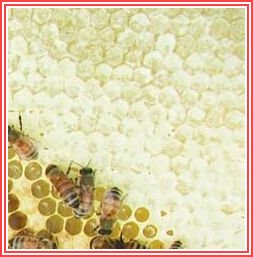
" Beeswax is the wax produced by worker bees from nectar and pollen.
These substances are converted in the body of the bee to wax, which then
exudes through wax pores on the ventral surface into 8 small moulds
and there hardens into small scales. When required it is plucked off,
made plastic with saliva, and used for building the honey comb and
capping the cells. Beeswax forms about one tenth of the total weight of the
honey comb. "
This not, inconsiderable figure representing 3kg for each 30kg of comb.
It must be allowed that in addition to the substances mentioned, there are
also further substances collected by the bee, e.g. Volatile Oils, Plant Wax
and Resins. These substances will also vary from each other depending
on the source from which they are collected. To further complicate the
matter there is also the problem of chemical spray residues.
Again the British Pharmacopoeia 1958, makes a nod to all of those
variables by usually specifying Cera Alba or bleached wax as the Official
substance. Commercially Cera Alba is produced by an acidified solution of
chromic acid and then washed in water. Obviously the wax has undergone
chemical change. The changes engendered will obviously depend upon the
original composition of the wax. The USD 1926 covers the ground well.
MARTINDALES 24th. THE EXTRA PHARMACOPOEIA (Br)
White Beeswax (B.P.). Cera Alba; White Wax (U.S.P.) Cire Blanche; Weisses
Wachs; Cera blanca.
Foreign Pharmacopeias: In all pharmacopeias examined.
Bleached beeswax. A yellowish-white solid with a faint characteristic odour.
M.p. 62 to 64 C
Yellow Beeswax (B.P.C.).
Cera Flava; Yellow Wax (U.S.P.) Cire Jaune; Gelbes Wachs; Cera amarilla.
Foreign Pharmacopeias: In all pharmacopeias examined
A secretion formed by the hive bee, Apis mellifera and other species of
Apis (Apidae), used by the insect to form the cells of the honeycomb. It is
a yellowish-brown solid with an agreeable honey-like odour, brittle when
cold, plastic when warmed. M.p. 62 to 65 C. Insoluble in water;
sparingly soluble in alcohol; soluble in chloroform, warm ether, and
fixed and volatile oils.
Uses. Yellow beeswax is used as an ingredient
of ointments and enables water to be incorporated to produce water-in-oil
emulsions. White beeswax is similarly employed.
Aseptic Surgical Wax (B.P.C.1949). Cera Aseptica Chirurgicalis;
Horsley's Wax; Bone Wax. A sterile mixture of yellow beeswax 7 and olive oil
2, with phenol 1, all by wt. Cover with a 0.2% w/v solution of
mercuric chloride and protect from light In sterile bottles In a cool
place. When required for use the container should be heated to 100 C for 5
minutes and the contents poured into a 0.2% w /v solution of mercuric
chloride warmed to 40 C. It is used for preventing haemorrhage in
cranial surgery.
Erlangen Cream (St. Bart's Hosp) White beeswax 2.5 oz. spermaceti 2
oz. arachis oil 20 fluid oz., water 7 fluid oz.
Galen's Wax. Cerat de Galien (Fr. P). White beeswax 130 g. almond oil 535 g.
distilled rose water 330 g. borax 5 g.
Unguentum Aquosum (Chin.P) White beeswax 18g borax 1g. almond oil 61g
water to100 g.
The U.S.D. 21st Ed. 1926
The U.S. Monograph also
includes the vegetable waxes used for adulterating beeswax.
CER.A ALBA. U.S. Br.
WHITE WAX Cer. Alb.
Yellow Wax, bleached. U.S. White Beeswax is Yellow Beeswax, bleached.
Br.
White Beeswax; Cire Blanche, Fr. Cod. Cera alba, P.G. Weisses Wachs, G.
Cera bianca. It.. Cera blanca, Sp.
CER.A FLA VA. U.S. Br.
YELLOW WAX Cer, Flav. [Beeswax]
Yellow Wax is obtained by melting and purifying the honey-comb of the bee,
Apis mellifera,
Linne (Fam Apidae) U.S. Yellow Beeswax is obtained from the honeycomb of
the Hive Bee, Apis mellifera, Linn., and possibly other species of Apis.
Br,
Yellow Beeswax. Cera Citrina. Beeswax. Cire Jaune, Fr. Cod. Cire d'
Abeilies, Fr. Cera Flava, P.G. Gelbes Wachs, G. Cera gialla, Cera vergine,
It. Cera amarilla, Sp.
The name Apis mellifera was given to the honeybee of Linnaeus in 1758,
Systema Naturae 10th edition; subsequently (Ibid. 12th edition,1767),
Linnaeus changed the name to mellifica, but according to the established
rules of scientific nomenclature the first name must hold, and the revisers
of the United States Pharmacopoeia were therefore correct in adopting it. It
was at one time doubtful whether the wax which constitutes the walls of the
honey-comb is elaborated or merely gathered by the insect. Huber, however,
by feeding bees exclusively on honey and water, determined that under these
circumstances wax is produced in the form of scales under the rings of
the abdomen. But wax also exists in plants, bearing in this, as in other
respects, a close analogy to the fixed oils.
Besides the official species other bees are used as honey makers. The
extremely vicious, blackish-brown Apis fasciata was kept by the ancient
Egyptians on floating apiaries, which as the season progressed slowly
drifted down the Nile, following the successive opening of the
flowers. In Senegal, Apis adansonii, and in Southern Africa, Apis caffra and
Apis Scutellata produce honey; while the Apis unicolor of Madagascar has
been domesticated in that island and introduced into other parts of the
world. In India honey is made in large quantities by Apis dorsata (Apis
indica, Apis florea) the largest bees known.
India Wax differs from official wax chiefly in its
lower acid value. A wax is also produced in India by the so-called Kota
bees, belonging to the genus Melipona, they are minute stingless
insects, which furnish a sticky, dark-colored wax, resembling in
physical and chemical characteristics the propolis of the honey bee rather
than the true wax.
Propolis or bee-glue is a brownish resinous
substance sometimes deposited at the base of the hive; apparently it
is collected from the resinous exudate of various trees such as the
balsam, poplar and conifers. It has been used in place of the afore
mentioned in various preparations. .
1.CERA FLAVA,
or Yellow Wax.-This is obtained by
slicing the comb taken from the hive, removing the honey by centrifugal
action, and melting the residue in boiling water, which is kept hot for some
time in order to allow the impurities to separate and either subside or be
dissolved by the water. When the liquid cools the wax concretes, and, having
been removed and again melted in boiling water, is strained and poured into
pans or other suitable vessels. The labor saving device is sometimes adopted
of stretching a strainer of cheese cloth upon a hoop and wedging the
latter down into the hot mixture below the level of the water; as this
cools, the melted wax slowly rises through the cloth, and thus a
perfectly clean cake of wax is formed on top on cooling. It is usually
brought to market in round flat cakes from three to six inches in
thickness.
Description and Physical
Properties. A solid,
varying in color from yellow to grayish brown. It has an agreeable,
honey-like odor, and a faint, characteristic taste. When cold, it is
somewhat brittle, and when broken presents a dull, granular,
non-crystalline fracture. Yellow Wax is insoluble in water and sparingly
soluble in cold alcohol. Boiling alcohol dissolves the cerotic acid
and a portion of the myricin, which are constituents of Yellow Wax. It
is completely soluble in chloroform, ether, and in fixed or volatile oils,
partly soluble in cold bezene or in carbon disulphide, and completely
soluble in these liquids at about 30C
Specific gravity: 0.950 to 0.960 at 25" C. determined as
follows: Melt the Wax at a low temperature, and allow it to fall in
separated drops from just above the surface into alcohol that has been
warmed to from 45" to 50" C. Allow the globules to remain in the
alcohol until it has cooled spontaneously to room temperature (20 to 25 C.),
then remove the Wax and keep it at room temperature for twenty-four
hours. Prepare a mixture of four volumes of alcohol and enough
distilled water to make ten volumes, and allow it to stand until free
from air bubbles. Moisten the globules of Wax with distilled water by means
of a brush, and place them by means of forceps in the alcohol solution just
prepared and contained in a beaker. Then add alcohol, or air-free distilled
water, as required, to the mixture, kept at 25C until the globules of the
Wax float and rest indifferently in the liquid. Finally determine the
specific gravity of the alcohol-water mixture. The figure thus obtained
represents the specific gravity of the Wax examined. Yellow Wax melts
between 62 and 65" C.
Boil 1Gm of Yellow Wax for half an hour with 35 cc. of an aqueous solution
of sodium hydroxide (1 in 7), the volume being preserved by the occasional
addition of distilled water on cooling, the Wax separates without
rendering the liquid opaque, and no precipitate is produced in the
liquid after filtration through glass wool or asbestos on the addition of an
excess of hydrochloric acid (fats or fatty acids, Japan wax, rosin or
soap). Warm about 3 Gm. of Yellow Wax, accurately weighed, in a 200
cc. flask with 25 cc. of neutral dehydrated alcohol until melted, add 1
cc. of phenolphthalein T.S. and while warm titrate with half normal
alcoholic potassium hydroxide until a permanent, faint pink color is
produced: the acid number so obtained is not less than 18 and not more
than 24. Now add 25 cc. of half normal alcoholic potassium hydroxide and 50
cc. of alcohol, boil the mixture for four hours under a reflux
condenser, and titrate the excess of the alkali with half-normal
hydrochloric acid: the ester number so obtained is not less than 72
and not more than 77. U.S.
A yellowish-brown solid; somewhat brittle when cold, but becoming plastic by
the heat of the hand. Agreeable, honey-like odor. Fracture granular, not
crystalline. Soluble in chloroform and in fixed and volatile oils.
Specific gravity 0.958 to 0.970. Melting point 61 to 64 C. Refractive
index at 80 C. 1.4380 to 1.4420. When 5 grammes are boiled for ten
minutes with 80 millilitres of an aqueous solution (1 in 10) of sodium
hydroxide, the water lost by evaporation being made up, the resulting
solution; cooled and filtered through asbestos, does not become turbid
when acidified with hydrochloric acid (absence of fats, fatty acids,
Japan wax, resin). 5 grammes heated with 20 millilitres of absolute
alcohol and shaken until uniformly distributed, require for
neutralisation at boiling temperature not less than 1.5 and not more
than 2.0 millilitres of N/1 alcoholic solution of potassium hydroxide,
solution of phenol phthalein being used as indicator (limits of free
acid). Upon the further addition of 20 millilitres of N /1 alcoholic.
solution of potassium hydroxide, and on well boiling for one and a
quarter hours in a flask to which a reflux condenser is attached, not
less than 13.2 and not more than 13.8 millilitres of N/1 solution of
sulphuric acid are required for neutralisation. When 5 grammes are
boiled with a mixture of 15 millilitres of N!1 alcoholic solution of
potassium hydroxide N/1 and 15 millilitres of absolute alcohol until
completely saponified, the alcohol evaporated, the residue dissolved
in 20 millilitres of glycerin on a water-bath and 30 millilitres of
boiling water added, a clear or translucent solution is obtained
(absence of ceresin, paraffin and other waxes). Not more than 1 per cent. is
soluble in boiling water (limit of honey)." Br.
Dieterich examined hundreds of specimens annually, and found the wax to
vary in sp. gr.
from 0.963 to 0.966;' He also determined the specific gravities of the
following substances some of which are used to adulterate wax.
white wax, 0.973; cera japonica, Japan wax, 0.975; ceresin, half white,
0.920; ozokerite, crude, 0.952; rosin, common, 1.108; cacao butter, 0.980 to
0.981; pure rosin, 1.045; beef suet, 0.952 to 0.953; yellow wax, 0.963
to 0.964, ceresin, white, 0.918; ceresin, yellow, 0.922 . spermaceti,
0.960; French rosin, 1.104 to 1.105 ; paraffin, med. hard, 0.913 to
0.914; stearin, A No.1, 0.971 to 0.972; mutton suet, 0.961.
2. CERA ALBA, Bleached
Yellow Wax, or White Wax. The color of yellow wax is discharged by exposing
it, with an extended surface, to the combined influence of air, light
and moisture. The process of bleaching is carried on to a considerable
extent in this country. The wax, previously melted, is made to fall in
streams upon a revolving cylinder, kept constantly wet, upon which it
concretes, forming thin ribbon-like layers. These, having been
removed, are spread upon linen cloths stretched on frames and exposed to the
air and light; care being taken to water and occasionally turn them. In a
few days they are partially bleached; but, to deprive the wax
completely of color, it is necessary to repeat the whole process once, if
not oftener. When sufficiently white, it is melted and cast into small
circular cakes. Yellow wax may also be decolorized by treatment with animal
charcoal or with potassium permanganate, potassium dichromate and
sulphuric acid, and hydrogen peroxide. White wax sometimes contains one or
more free fatty acids, consequent probably upon the employment of
alkalies in bleaching it, which render it an unfit ingredient in the
unctuous preparations of certain salts. It may be deprived of these
acids by means of alcohol.
WHITE WAX is less unctuous to the touch than the
yellow, soft and ductile at 35 C. and fusible at 65 C. retaining its
fluidity at a lower temperature.
Description and Physical
Properties. A
yellowish-white solid, somewhat translucent in thin layers. It has a faint,
characteristic odor, is free from rancidity, and is nearly tasteless.
The acid value is not less than 17 and not more than 23, and the ester
value not less than 72 and not more than 79, as determined by the
methods under Cera Flava. In other respects White Wax has the
characteristics of, and responds to, the tests for identity and purity under
Cera Flava. U.S. Hard, nearly white, translucent cakes or masses. 5 grammes
heated with a mixture of 10 millilitres of alcohol (90 per cent.) and 10
millilitres of absolute alcohol) and shaken until evenly distributed,
require for neutralisation at boiling temperature not less than 1.5
and not more than 2.2 millilitres of N/1alcoholic solution of
potassium hydroxide, solution of phenolphthalein being used as
indicator (limits of free acid). In other respects White Beeswax
responds to the tests described under Cera Flava. By a great heat it
is partly volatilised and partly decomposed; and, when flame is applied to
its vapor, it takes fire and burns with a clear bright light. It is
insoluble in water, and in cold alcohol or ether, but is slightly
soluble in boiling alcohol and ether, which deposit it in a great
measure upon cooling. The volatile and fixed oils dissolve it with
facility, rosin readily unites with it by fusion, and soaps are formed
by the action of sodium and potassium hydroxides. It is not affected
by the acids at ordinary temperatures, but is converted into a black
mass when boiled with concentrated sulphuric acid.
Composition.
The chief constituent of beeswax is
myricin (myricyl palmitate); melting point 64C. It also contains
cerotic acid (formerly called cerin), C26H52O2, and
melissic acid, C30H60O2. There are also present about 6 per cent. of hydrocarbons
of the paraffin series, including heptacosane, C27H56, and hentracontane, C31H64. Myricyl alcohol, C30H61OH, is liberated when myricyl palmitate is saponified, as
glycerol is liberated during the saponification of ordinary fats; when fused
with potash lime it is converted into potassium melissate, KC30H59O2. Hot
alcohol extracts the cerotic and melissic acids ,from beeswax.
Saponification, of course, decomposes the myricyl palmitate.
Schwalb (Ann; Chem., ccxxiv, 225) found melissic acid and some
unsaturated acids of the oleic series; also higher solid hydrocarbons of the
saturated series, such as C27H56 and C31H64.
Kebler states that the hydrocarbons in beeswax amount to from 12.72 to
13.78 per cent.
(A.J.P. 1893,587.) T. Marie believes that cerotic acid, as ordinarily
obtained, is a mixture of two distinct acids. He gives C30H60O2 as the
formula for melissic acid and C25H50O2 for pure cerotic acid.
Adulterations. Wax
has been variously adulterated. Heavy substances sink to the bottom of
the vessel when the wax is melted. Starch meal, and other insoluble
substances remain behind when the Wax is dissolved in oil of turpentine or
petroleum benzin. Water, which, is said to be sometimes fraudulently
incorporated with it, by agitation when partially melted, is driven
off by heat. Fatty substances render lime water turbid when agitated with it
and allowed to stand. The best test for fats, fatty acids, or rosin is the
pharmacopeia test of boiling with sodium hydroxide solution and testing the
filtrate obtained after cooling. For the detection of rosin, cold
alcohol is sufficient. It dissolves the rosin, and yields it on
evaporation, attended with a very small portion of pure Wax, which
yields 2.4 per cent. to cold alcohol. F. Jean states that a few drops
of sulphuric acid added to the melted wax adulterated with rosin, cause a
red color, or, if only 1 per cent. be present, a green tint.
(A. J. P., 1881,p. 307.)
To detect Japan wax, Dullo boils together for a minute 10 Gm.
of wax, 120 Gm. of water, and 1 Gm. of sodium hydroxide; if Japan wax
be present, a soap will immediately form, which will slowly solidify
on cooling. Beeswax does not saponify under these circumstances.
Ceresin, a principle obtained from ozokerite (see Part II), is also
employed as an adulterant, and is manufactured largely for that
purpose in Vienna. It is only native paraffin, and of course answers
to the tests for that substance. There are other less precise methods of
detecting adulterations. Thus, spermaceti and lard render wax softer
and less cohesive, of a smoother and less granular fracture, and of a
different odor when heated. The melting point and specific gravity are
lowered by tallow, suet, lard, and especially by paraffin. Legrip's
cereometer is based upon the altered specific gravity of wax when
adulterated. Anyone may apply this principle by making such a mixture
of alcohol and water that pure wax will neither sink nor rise in it,
but remain wherever placed. Adulterated wax would either float or sink
in this liquid. The most valuable information, however, is obtained by the
determination of the chemical constants-viz., acid value, ester value,
and saponification value. In yellow wax the iodine value is also of use;
in white wax the bleaching process has altered the bodies which absorb the
iodine; (See also Chem. Ztg., 1893, 918; Proc. A. Ph. A., 1894, 957 ; D. C.,
1898,33; Am. Drug., 1898,97, and 1904, 103,105.) According to G. Brehner (Ztsch.
Off Ch., 1912, No.5), who has investigated many samples of beeswax of
normal and abnormal character, beeswax may be divided into three
groups, according to source, as follows:
(1) Ordinary beeswax in which the ratio of
acid number to ester number is 1:3.6 to 1 : 4.
(2) Beeswax of African origin in which the
ratio is 1 : 3.
(3) Beeswax of Indian origin in which the
ratio is 1 : 12. A Leijs (J.P.C. 1912, No.12) describes a method-based
on the relative solubility in fuming hydrochloric acid, which, he
claims, enables him with certainty to separate paraffin, ceresin, and
carnauba wax readily from beeswax. Under the name of White Wax No.2 or White
Wax for technical use, there has 'been found in commerce a product put
up in exact imitation of white beeswax, and consisting of over 90 per cent.
of paraffin.