
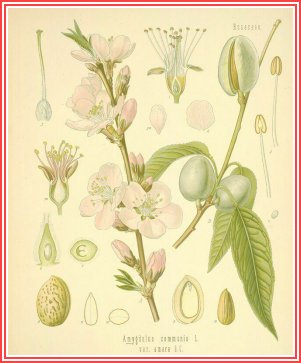
Almond Oil Br. US
Compiled and Edited by
Ivor Hughes
(1) A Textbook
of Pharmacognosy. Denston T.C. (Br.)
(2) United States Dispensatory 1926
(1) A Textbook
of Pharmacognosy. Denston T.C. (Br.)
This is an abbreviated extract.
Synonyms: Sweet Oil of Almond; Expressed Almond
Oil.
Official Source :
The seeds of - (i) Prunus amygdalus Batsch. var. dulcis (DO.) Koehru (Sweet Almond)
(ii) Prunus amygdalus Batsch., var. amara (DO.) Focke (Bitter Almond)
Fam : Rosaceae.
Geographical Source :
Spain, Southern France, for sweet almonds. Morocco and Sicily, for bitter
almonds.
Preparation
: By cold expression, sweet almonds yielding about 45 per cent and bitter
almonds, the chief source, about 40 per cent of oil.
Constituents :
Glycerides, the fatty acid constituents of which are chiefly oleic acid with
smaller amounts of palmitic, linoleic and myristic acids.
| Tests : The four adulterants for which specific tests are prescribed are ; 1. Cottonseed oil -- detected by Halphen's test. 2. Sesame oil --detected by Baudouin's test. 3. Arachis Oil --detected by the tests referred to on page 512. 4. Apricot Kernel oil and Peach Kernel oil-detected as follows: The reagent used is Bieber's, and consists of equal weights of sulphuric acid, fuming nitric acid, and water-freshly mixed before use. |
The test is as
follows.
Thoroughly shake 5 ml. of oil with 1 ml. of reagent and set aside for 15
minutes. If the almond oil is free from kernel oils, a mixture either
whitish or with but the faintest reddish-brown tinge will be formed, and
upon standing for some hours (during which time the mixture separates into
two layers) the lower (acid) layer will be colourless. If kernel oils
are present to the extent of 20 per cent or more, the mixture will be
reddish-brown-the degree of coloration depending upon the proportion
of kernel oils present. The Pharmacopoeia requires negative results with all
the above tests.
Source : (Br) A Textbook
of Pharmacognosy. Denston T.C.
(2) United States Dispensatory 1926
OLEUM AMYGDALAE
EXPRESSUM. U. S.
(Br.) EXPRESSED OIL OF ALMOND. Ol. Amygd. Exp. Oil of Sweet Almond. The
fixed oil obtained from the kernels of varieties of Amygdalus communis.
This oil is obtained equally pure from sweet and from bitter almonds. In its
preparation, the almonds, having been deprived of a reddish-brown powder
adhering to their surface, by being rubbed together in a piece of coarse
linen, are ground in a mill resembling a coffee-mill, or bruised in a
stone mortar, and then pressed in canvas sacks between plates of iron
slightly heated. The oil, which is at first turbid, is clarified by
rest and filtration. Sometimes the almonds are steeped in very hot
water, deprived of their cuticle, and dried in a stove, previous to
expression. The oil is thus obtained free from color, but in no other
respect better, while it is more likely to become rancid on keeping.
Bitter almonds treated in this way impart an odor of hydrocyanic acid to the
oil. The yield of oil from the sweet almond is from 40 to 55 per cent. and
slightly less from the bitter. Though sometimes expressed in this country
from imported almonds, the oil is generally brought from Europe.
Description and Physical
Properties.
A clear, pale straw-colored or colorless, oily liquid. It is almost
odorless, and has a bland taste. It is slightly soluble in alcohol,
but is miscible with ether, chloroform, benzene, and with petroleum
benzin.
Saponification value: not less than 191 and not
more than 200. Iodine value: not less than 93 and not more than 100.
Preserve in well .closed containers.
U.S. Pale yellow. Nearly inodorous; taste
bland and nutty. Specific gravity 0.915 to 0.920.
Saponification value 183
to 196; iodine value 93 to 100; acid value not more than 6.0.
Refractive index at 40 C. 1.4624 to 1.4640. Remains clear
after exposure for three hours to a temperature of -10 C., and does
not congeal till the temperature has been reduced to about -18C. When
1 milliliter of a freshly prepared mixture of equal parts by weight of
sulphuric acid) fuming nitric acid, and water, kept cool while
cautiously mixed, is vigorously shaken with 5 milliliters of the Oil
for one minute, a whitish mixture with not more than the very
slightest tinge of red or brown is produced ; after some hours a white
solid, sometimes tinged with green, separates, the lower acid layer
remaining colorless (absence of peach oil and apricot oil)." Br. ,
Expressed oil of almond consists chiefly of olein with traces of
linolein; there is no stearin present. It belongs among the
"non-drying" oils. It is sometimes adulterated with oils from peach or
apricot kernels; these are excluded by the test of the U.S.
Uses.-.The expressed oil of almonds possesses
the emollient properties of the other fixed oils over most of which it has
the advantage of comparative tastelessness, and freedom from odor and
its lack of tendency to become gummy.
AMYGDALA DULCIS.
Br. SWEET ALMOND Amygd. Dulc:
Sweet Almond is the ripe seed of Prunus Amygdalus Stokes, var. dulcis, Baill.
Known in commerce as the Jordan almond.
Br. Semen Amygdali : Dulce; Amandee douce., Fr. Cod; Amyg- dalmDulce.,
P. G.; Susse Mandeln,
G.; Mandorle dolci,
It.;
Almendra dulce,
Sp. For description of the almond tree see
Amygdala Amara.
We are supplied with sweet almonds chiefly from Spain, Italy, France, and
Southern California. They are seperated into the soft-shelled and
hard-shelled, the former of which come from Marseilles and Bordeaux,
the latter from Malaga. From the latter port they are sometimes
brought to us without the shell. In British commerce, the two chief
varieties are the Jordan and Valencia almonds, the former imported
from Malaga, the latter from Valencia. The former are longer,
narrower, more pointed, arid more highly esteemed than the latter.
Properties.-Each kernel consists of two white
cotyledons, enclosed in a thin, yellowish- brown, bitter skin, which. is
easily separable after immersion in boiling water. Deprived of this
covering, they are called blanched almonds. On exposure to the air
they are apt to become rancid; but, if thoroughly dried and kept in
well-closed glass vessels, they may be preserved unaltered for many
years. Sweet almonds, when blanched, are without odor, and have a sweet,
very pleasant taste, which has rendered them a favorite article of
diet in all countries where they are readily attainable. " About two
and a half centimeters or somewhat more in length, nearly oblong in
outline, more or less compressed, pointed at one extremity and rounded at
the other. Testa cinnamon- brown, thin and scaly. Seed exalbuminous,
containing two large planoconvex oily cotyledons. Taste bland; when
triturated with water forms a white emulsion with no marked odor." Br.
.
The U. S. IX gave the following description of the microscopic
appearance. " The powder is creamy-white, exhibiting numerous very small
oil. globules, 0.001 mm. or less in diameter, and larger oil globules
and crystalloids, the latter sometimes with adhering globoids;
fragments of parenchyma of endosperm, containing oil globules and
aleurone grains; also occasional fragments of seed coat with
characteristic, more or less scattered, large elliptical, thin-walled,
strongly lignified epidermal cells and narrow, closely spiral
tracheae. Starch grains are absent." U. 8. IX. .
Shelled Almonds are sometimes substituted by the kernels of the peach,
plum and apricot. The stone cells in the epidermal layer of the almond
are much larger than in the kernels of the substitutes. For
microscopic distinctions see Winton and Moeller,'
The Microscopy of Vegetable Foods." Almond cake, a by product in the
manufacture of almond oil, is largely used in the preparation of a class of
detergent powders known as "almond meal." It is also used as a diabetic food
and sometimes as an adulterant of ground spices and powdered drugs. By
the analysis of Boullay, it appears that almonds contain 54 parts of
fixed oil, 24 of protein, 6 of uncrystallizable sugar, 3 of gum, 9 of
fibrous matter, 3.5 of water, and 0.5 of acetic acid, comprising loss.
The protein is somewhat peculiar, consisting of amandin and emulsin,
the latter being an enzyme. It may be obtained separate by treating
the emulsin of almonds with ether, allowing the mixture, after
frequent agitation, to stand until a clear fluid separates at the
bottom of the vessel, drawing this off by a siphon, adding alcohol to it so
as to precipitate the emulsion, then washing the precipitate with fresh
alcohol, and drying it under the receiver of an air pump. In this
state it is a white powder, inodorous and tasteless, soluble in water,
and insoluble in ether and alcohol. Its solution has an acid reaction,
and, if heated to 100 C., becomes opaque and milky, and gradually
deposits a snow-white precipitate, amounting to about 10 per cent. of
the protein employed. The distinguishing characteristic of the emulsin
is that of producing certain changes noticed previously in amygdalin,
which property it loses when its solution is boiled, although not by
exposure in the solid state to a heat of 100 C. It consists of nitrogen,
carbon, hydrogen, and oxygen, with a minute proportion of Sulphur, and
is probably identical with the synaptase of Robiquet. L. Portes has
reported asparagin in sweet almonds. (N. R., January, 1877.)
The fixed oil is described under the head of Oleum .Amygdala1
Expressum, to which the reader is referred. Sweet almonds, when rubbed
with water, form a milky emulsion, free from the odor of hydrocyanic acid,
the insoluble matters being suspended by the agency of the albuminous,
mucilaginous, and saccharine principles.
Uses.-Sweet almonds have no other
influence on the system than that of a nutrient and demulcent. The emulsion
formed by triturating them with water is a pleasant vehicle. From their
nutritive properties, and the absence of starch in their composition, they
are valuable used in the diet of diabetics. Care must be taken when
almond meal is directed to be taken as a food product, as in diabetes,
that neither bitter almond meal, which is poisonous, or the factitious
product, which contains soap and is inedible, is supplied. .Almond
meal or almond press cake is used for cosmetic purposes as an addition
to the bath or to the water used in washing the face and hands. Much
of the so-called almond meal used for this purpose is factitious or
adulterated. Off. Prep.Mistura Amygdalre, Br. Pulvis Amygdalre
Compositus, Br.
More information may be found in the articles dealing with the
volatile or
essential oils.
